Franchise Opportunities in Melbourne: The Complete Investment Guide for 2026
Melbourne is more than Australia’s cultural capital. It is one of the country’s largest and most diverse consumer and business markets, creating a strong environment for entrepreneurs looking to invest in established business models. The city has more than 5.2 million people and has added over one million residents in the past decade, supporting demand across healthcare, retail, education, food, and lifestyle services.
For investors, franchising offers a way to enter this market with an established brand, proven systems, and structured support. But with opportunities across so many industries, choosing the right franchise requires a closer look at Melbourne’s economy, population trends, business environment, and local demand.
Key Takeaways
- Melbourne offers access to a large and diverse consumer market.
- Population growth continues to create demand for new products and services.
- Healthcare, food, education, beauty, fitness, and essential services offer varied franchise opportunities.
- A franchise provides an established business framework, but location and market demand remain critical.
- Investors should evaluate the brand, total investment, support, competition, and scalability before committing.
Melbourne Franchise Market Overview (2026)
Melbourne enters 2026 with a sizable consumer market and a business environment supported by population growth, employment, and investment. Greater Melbourne has more than 5.2 million residents, while Victoria’s population exceeds 7 million. The city also provides businesses with access to a broader Australian market and a large network of potential B2B customers.
The wider Victorian economy is forecast to grow by 1.5% in 2026–27, while population growth is forecast at around 1.7%. Employment is also expected to continue growing. For franchise investors, these conditions point towards continued demand for consumer-facing and service-based businesses, particularly those aligned with changing lifestyles and essential needs.
Why Melbourne is a Strong Franchise Market
What makes Melbourne attractive isn’t just its size. It is the combination of population growth, economic activity, skilled talent, and diverse consumer demand that gives franchise businesses multiple avenues for growth.
Strong and Diverse Economy
Melbourne sits within Australia’s south-east economic corridor, which accounts for a significant share of national economic activity. Its economy spans professional services, technology, healthcare, education, retail, manufacturing, and other industries, giving entrepreneurs access to a broad customer and business base.
This diversity matters for franchising. Investors are not dependent on a single consumer trend or industry. Whether the business serves families, professionals, students, businesses, or health-conscious consumers, Melbourne offers multiple customer segments to target.
Growing Population and Consumer Demand
A growing population creates something every franchise needs: new customers. Melbourne has added more than one million residents over the past decade, while Greater Melbourne is projected to reach around 8.04 million people by 2051.
This expansion is creating demand across everyday services, from food and retail to healthcare, education, fitness, and personal care. For franchise investors, population growth can also open opportunities in developing suburbs where new communities need convenient local services.
Business-Friendly Environment
Victoria is actively working to make it easier for businesses to invest and grow. The Victorian Government’s Economic Growth Statement includes more than 40 initiatives supported by a $627 million investment, alongside efforts to reduce regulatory burden and encourage productivity.
For franchise investors, a supportive business environment can make market entry and expansion more attractive. However, investors still need to understand the specific legal, licensing, employment, and commercial requirements applicable to their chosen franchise.
Access to Skilled Workforce
A successful franchise needs more than customers; it needs people who can deliver the service consistently. Melbourne benefits from a large and highly educated workforce, supported by its universities, training institutions, and diverse population. Invest Victoria describes the city as a young, skilled, and multicultural market.
This can be particularly valuable for healthcare, education, technology, professional services, and other specialised franchises where trained employees are central to business performance. Victoria is also projected to add around 373,000 workers over three years, with healthcare and social assistance among the sectors expected to see the strongest workforce growth.
Expanding Residential and Commercial Areas
Melbourne’s continued population growth is reshaping where consumers live, work, and spend. New residential communities and expanding suburban areas create fresh demand for local retail, healthcare, education, fitness, food, and household services.
For franchise investors, this creates an important location advantage. Instead of competing only for space in established commercial centres, entrepreneurs can identify growing neighbourhoods where demand may be developing faster than the supply of services. The key is choosing a location based on population profile, accessibility, competition, rental costs, and the specific needs of the surrounding community.
What Franchise Opportunities Are Available in Melbourne?
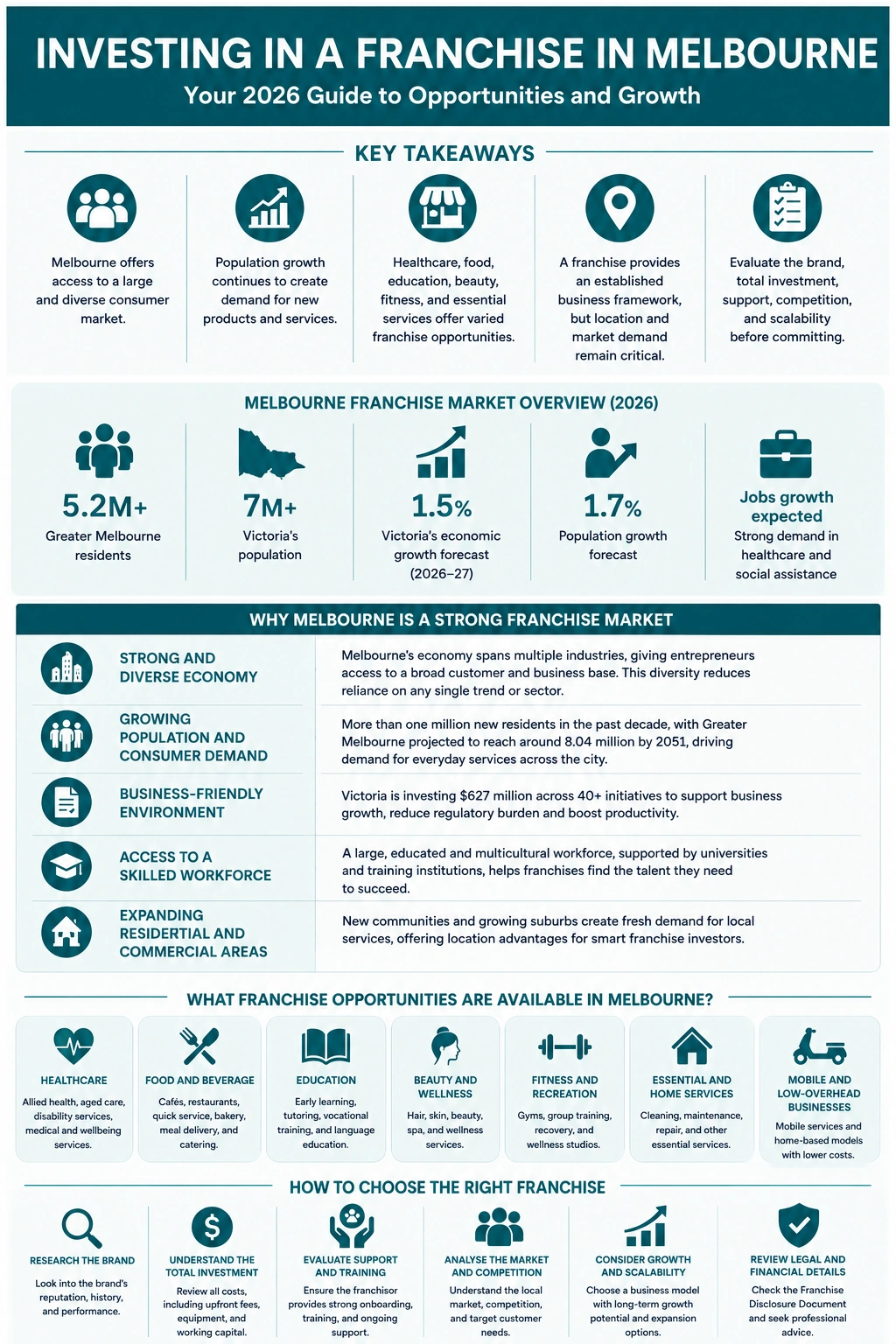
Melbourne’s diverse population and established business environment create opportunities across healthcare, food, retail, services, and mobile business models. The advantage for investors is choice: they can select a franchise based on their capital, skills, preferred operating style, and target customers. Australia’s franchise ecosystem includes a wide range of established brands, while the government provides dedicated guidance around franchise agreements, costs, and obligations.
1. Healthcare Franchises
Healthcare offers one of the more specialised franchise opportunities in Melbourne, particularly across medical services, wellness, diagnostics, and aesthetic healthcare. Hair restoration is another focused segment where entrepreneurs can build a premium healthcare business around specialised treatments. DHI International offers a dedicated hair restoration franchise model, with its network spanning 75 clinics across 45 countries and more than 56 years of experience in hair restoration. For entrepreneurs, the appeal lies in combining a specialised healthcare service with an established brand, clinical training, operational systems, and franchise support. As healthcare needs continue to evolve, specialised services can offer a differentiated route into Melbourne’s competitive business market.
Invest in Healthcare Franchise in Melbourne
Join DHI Today2. Service Franchises
Service franchises can be attractive because they often address recurring everyday needs without requiring a large customer-facing retail footprint. Melbourne offers opportunities across cleaning, home maintenance, property services, automotive care, and other essential services. Brands such as Fantastic Services actively offer cleaning franchise opportunities in Melbourne, with training, coaching, software, and operational support included within its model. These businesses can suit entrepreneurs who prefer service-based operations and potentially lower infrastructure requirements than traditional storefront businesses. The right opportunity still depends on territory availability, customer demand, staffing, vehicle or equipment requirements, and the level of support provided by the franchisor.
3. Food Franchises
Food remains one of the most recognisable franchise categories in Australia, covering cafés, quick-service restaurants, takeaway concepts, desserts, bakeries, and casual dining. Melbourne’s diverse population creates room for different cuisines and dining formats, from established national chains to specialised food concepts. The opportunity is not simply about opening a popular restaurant; location, foot traffic, delivery demand, rent, staffing, and local competition can have a major impact on performance. Entrepreneurs should therefore compare the complete franchise model rather than focusing only on brand recognition. A strong food franchise combines an established concept with operational systems, supplier relationships, marketing support, and a location suited to the target customer.
4. Retail Franchises
Retail franchising gives entrepreneurs access to established brands, supplier networks, merchandising systems, and customer recognition. Opportunities can span convenience, specialty retail, fashion, health products, automotive products, and other consumer categories. Melbourne’s large and diverse population provides multiple customer segments, but retail investors need to be particularly careful about location and occupancy costs. A franchise operating in a high-traffic shopping precinct may have very different economics from one serving a suburban community. Before investing, assess the brand’s Australian presence, territory rights, inventory requirements, margins, lease obligations, and support structure. Understanding these factors can help determine whether a retail franchise fits both the local market and your investment capacity.
5. Mobile Franchises
Mobile franchises offer a different approach to business ownership by taking products or services directly to customers rather than relying on a permanent storefront. Depending on the model, opportunities can include mobile food, automotive services, cleaning, repairs, pet care, and other on-demand services. This can reduce the need for traditional retail premises while allowing entrepreneurs to serve multiple suburbs or customer groups. However, the model requires careful planning around travel time, vehicle costs, scheduling, territory, equipment, and customer acquisition. For Melbourne investors, a mobile franchise can be particularly appealing when the service addresses a recurring need and the franchisor provides established systems for generating and managing customer enquiries.
How Much Does a Franchise Cost in Melbourne?
There is no single franchise price for Melbourne. Investment can range from relatively accessible service-based models to significantly larger healthcare, retail, and food businesses requiring premises, equipment, staffing, and substantial working capital. Australia’s business.gov.au recommends calculating both startup and ongoing costs, including equipment, insurance, wages, rent, supplies, and other operating expenses.
The franchise fee is only one part of the calculation. Investors should also consider:
- Initial franchise fee
- Premises and fit-out
- Equipment and technology
- Staff recruitment and training
- Marketing and launch expenses
- Rent, insurance, and utilities
- Working capital
- Ongoing royalties and other franchise payments
The actual investment should therefore be assessed from the complete financial picture, not just the advertised entry fee.
Why Healthcare Franchises Are Gaining Popularity in Melbourne
Healthcare is increasingly moving beyond traditional hospitals and general medical practices. Melbourne’s growing population and expanding demand for specialised services are creating opportunities across wellness, diagnostics, aesthetics, rehabilitation, and hair restoration. Healthcare also offers something particularly valuable to franchise investors: services are often built around specific patient needs rather than short-term consumer trends.
Hair restoration is an especially interesting segment within this landscape. As awareness of modern transplant techniques increases, specialised clinics can serve consumers looking for professional, long-term solutions. This creates an opportunity to build a focused healthcare business rather than competing across a broad range of medical services. For entrepreneurs, the combination of specialised demand, premium treatment services, and an established franchise framework makes healthcare an increasingly compelling category to explore in Melbourne.
Why DHI is the Top Franchise Opportunity in Melbourne
When evaluating healthcare franchises, the real question is not simply which brand is recognised. It is whether the opportunity combines specialised expertise, an established business model, clinical training, and the support required to build a local practice. This is where DHI International stands out in the hair restoration segment.
DHI has more than 56 years of experience in hair restoration, operates 75 clinics across 45 countries, and has treated more than 500,000 patients worldwide. Its franchise model provides access to its specialised DHI technique, international training through the London Hair Restoration Training Academy, operational guidance, and marketing support.
For Melbourne entrepreneurs looking to enter a specialised healthcare market, DHI offers a structured opportunity to build a hair restoration business around an established global framework rather than developing the clinical and operational model independently.
Start Franchise Business in Melbourne
Join DHI TodayConclusion
Melbourne’s franchise market gives entrepreneurs plenty of choice, from food and retail to mobile services, home businesses, and specialised healthcare. But the strongest opportunity depends on more than market popularity. Investment requirements, location, customer demand, operating costs, brand strength, and franchisor support all need to be considered before making a decision.
For entrepreneurs interested in healthcare, hair restoration offers a more specialised route into Melbourne’s growing service economy. DHI International brings decades of hair restoration expertise, an established franchise model, dedicated training, and international operational experience to this segment. For an investor seeking a focused healthcare business with a recognised global framework, a DHI franchise is an opportunity worth exploring.
FAQs
1. Which franchise businesses are most profitable in Melbourne?
Healthcare, food and beverage, retail, education, beauty, and service franchises offer strong profit potential in Melbourne. Actual profitability depends on location, customer demand, investment size, operating costs, brand strength, and effective day-to-day management.
2. Is Melbourne a good city for first-time franchise investors?
Yes, Melbourne can be a strong choice for first-time investors because established franchises provide structured business models, training, and operational support. Its large consumer market also offers opportunities across healthcare, food, education, retail, and services.
3. Can international investors buy a franchise in Australia?
Yes, international investors can explore franchise opportunities in Australia, subject to applicable business, investment, immigration, and regulatory requirements. The specific requirements depend on the investor’s circumstances, business structure, industry, and proposed franchise activities.
4. How long does it take to recover a franchise investment?
The recovery period varies by franchise, investment size, location, revenue, operating costs, and customer demand. Investors should review realistic financial projections, expected break-even timelines, and ongoing expenses before committing to a particular franchise.
5. What are the ongoing royalty fees?
Royalty fees vary between franchise brands and agreements. They may be structured as a percentage of revenue, a fixed amount, or another agreed arrangement. Marketing contributions and technology fees may also apply, depending on the franchise.
6. Which healthcare franchise opportunities are available in Melbourne?
Melbourne offers healthcare franchise opportunities across medical services, diagnostics, wellness, aesthetics, and hair restoration. DHI International provides a specialised hair restoration franchise model supported by clinical training, operational guidance, marketing resources, and its established DHI technique.
7. What should I check before signing a franchise agreement?
Review the franchise fee, royalties, marketing contributions, territory rights, renewal terms, supplier requirements, responsibilities, exit conditions, training, and support. Australian franchise buyers should also carefully review the required disclosure documents before signing the agreement.
8. How do I finance a franchise purchase?
Franchise purchases can be funded through personal capital, business loans, commercial finance, or a combination of funding sources. Your financing options depend on the investment amount, business plan, financial position, lender requirements, and franchise model.
9.Are franchise businesses less risky than independent businesses?
A franchise can reduce some startup uncertainty through an established brand, proven systems, training, and support. However, it still involves financial and operational risks. Success depends on location, management, market demand, costs, and business execution.