Franchise Business vs Independent Business in Vietnam : Which Is Better
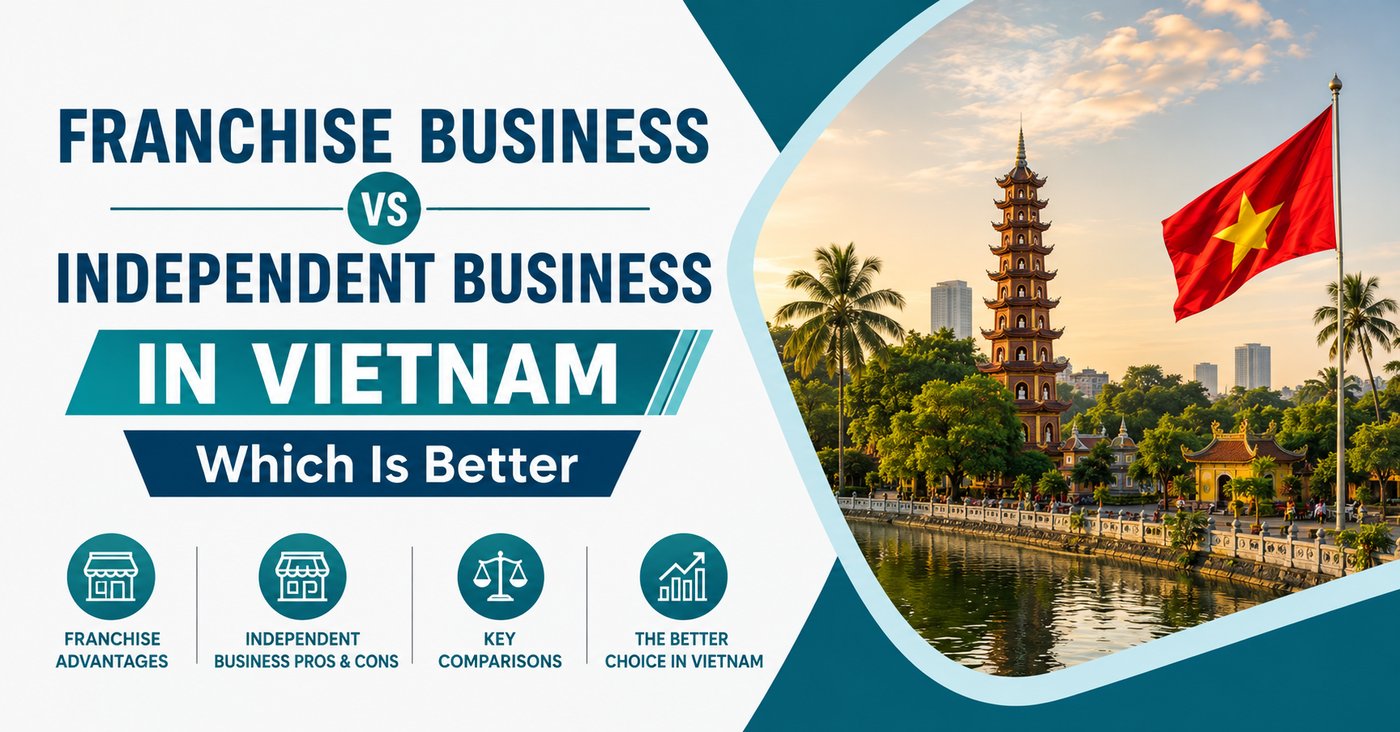
Starting a business in Vietnam can take two very different paths. You can build your own brand, develop your systems, and make every decision independently. Or, you can enter an established market through a franchise and work with a proven business model.
Both approaches have their strengths, but the better choice depends on your capital, experience, risk tolerance, and long-term goals. Vietnam’s growing consumer market has created opportunities for both independent entrepreneurs and franchise investors across healthcare, food and beverage, education, beauty, retail, and other sectors.
This guide compares franchise businesses vs independent businesses in Vietnam, so you can understand what each model offers before deciding where to invest.
Key Takeaways
- A franchise offers an established brand, proven systems, and structured support.
- An independent business provides greater control over branding, pricing, and operations.
- Franchising can reduce some startup uncertainties but involves fees and contractual obligations.
- Independent businesses offer greater flexibility but require entrepreneurs to build everything from the ground up.
- The right model depends on your investment capacity, experience, risk appetite, and growth plans.
Understanding the Vietnamese Business Landscape
Vietnam’s growing economy has opened doors for entrepreneurs across both established and emerging industries. Rising consumer spending, urbanisation, digital adoption, and changing lifestyles are creating demand for businesses ranging from restaurants and retail stores to healthcare and specialised services.
For Vietnamese entrepreneurs, this means there is no single formula for starting a successful business. Some may prefer the freedom of creating their own brand, while others may value the structure and recognition offered by an established franchise. Understanding these differences is the first step towards choosing a model that fits your ambitions.
What Is a Franchise Business?
A franchise allows an entrepreneur, known as the franchisee, to operate a business using an established company’s brand, systems, products, and operating methods. In exchange, the franchisee typically pays an initial fee and may also pay ongoing royalties or other charges.
The appeal is straightforward: instead of spending years developing a brand and testing a business model, entrepreneurs can enter the market with an established framework. This can be particularly useful for investors who want structured guidance while building a business in Vietnam.
1. How a Franchise Business Works
The process usually begins when an entrepreneur selects a franchise and applies to become a franchisee. After approval, the franchisor provides access to its brand, operating systems, training, and other agreed support.
The franchisee invests capital, manages the local business, follows the franchisor’s standards, and handles day-to-day operations. The franchisor, meanwhile, protects the brand and provides ongoing assistance according to the franchise agreement. This creates a partnership where both sides have defined responsibilities.
2. Benefits of Buying a Franchise
A franchise can provide several advantages for entrepreneurs entering a competitive market:
- Established Brand: Customers may already recognise and trust the brand.
- Proven Business Model: Operating processes have already been developed and tested.
- Training & Support: Franchisees can receive guidance in operations, marketing, staffing, and other areas.
- Marketing Assistance: Established franchise systems often provide brand-level promotional support.
- Faster Market Entry: Entrepreneurs don’t have to build awareness from zero.
For first-time business owners, this structure can provide valuable guidance while they learn to manage their investment.
3. Challenges of Running a Franchise
Franchising also comes with limitations. The initial investment can be significant, particularly for established international brands. Franchisees may also have to pay ongoing royalties, marketing fees, or other agreed charges.
There’s also less freedom than running an independent business. Pricing, branding, suppliers, products, and operational procedures may need to follow franchisor guidelines. Before investing, entrepreneurs should carefully understand the franchise agreement, financial commitments, territory rights, renewal terms, and exit conditions.
What Is an Independent Business?
An independent business is built and operated without relying on an established franchise brand. The entrepreneur develops the concept, chooses the business model, creates the brand, determines pricing, and manages operations independently.
This approach gives Vietnamese entrepreneurs complete ownership over how their business develops. It can be especially attractive to people who have a unique idea, strong industry experience, or a clear understanding of an underserved local market.
1. How an Independent Business Operates
The entrepreneur is responsible for almost every stage of the business journey. This includes identifying the market opportunity, developing products or services, creating the brand identity, selecting suppliers, hiring employees, developing marketing strategies, and establishing operating procedures.
There is no franchisor providing a ready-made framework, so the owner has complete responsibility for testing, refining, and scaling the business. This requires strong planning, decision-making, and financial management.
2. Advantages of Starting Your Own Brand
The biggest advantage is freedom. Entrepreneurs can make decisions based on their customers and local market instead of following a franchisor’s established rules.
They can:
- Set their own pricing and offers
- Build a completely original brand
- Change products or services quickly
- Choose their own suppliers
- Develop their own marketing strategy
- Retain greater control over business decisions
If the concept succeeds, the entrepreneur also owns the brand and can eventually expand it through additional locations or even develop their own franchise network.
3. Challenges of an Independent Busines
The freedom of independence also comes with greater responsibility. Entrepreneurs must build brand awareness, establish customer trust, develop operating systems, and test their products or services without an established franchise framework.
There is also no guaranteed customer base or proven formula for success. Mistakes in pricing, location, marketing, staffing, or product development can become costly. For someone without prior business experience, the learning curve can therefore be considerably steeper than entering a franchise with structured training and support.
Challenges to Consider on Both Sides
Neither model is risk-free. The difference is where the risk sits. With a franchise, you gain an established system but give up some control. With an independent business, you keep full control but take responsibility for building the system yourself.
Franchise Business Challenges
- Upfront and Ongoing Costs: Franchisees may need to pay an initial franchise fee, royalties, marketing contributions, and other operating costs. These expenses can reduce margins, particularly during the early stages of the business.
- Limited Flexibility: Franchise owners generally need to follow established guidelines for branding, products, pricing, suppliers, and operations. This can make it harder to respond quickly to local preferences or introduce ideas independently.
- Dependence on the Brand: Your business reputation is connected to the franchisor. Poor decisions, negative publicity, or declining performance at the wider brand level can affect individual franchise locations.
- Contractual Commitments: Franchise agreements define territory, renewal, termination, and operating requirements. Investors should understand these obligations carefully before committing capital.
Independent Business Challenges
- Building Brand Recognition: An independent business starts without an established customer base, meaning the owner must invest time and money into creating awareness and earning trust.
- Testing the Business Model: Products, pricing, marketing channels, and operating processes need to be developed and refined by the entrepreneur.
- Higher Learning Curve: Owners are responsible for decisions across hiring, suppliers, finance, marketing, customer service, and compliance, which can be demanding without prior experience.
- Slower Initial Growth: Building a reputation organically can take longer than entering the market under a recognised franchise brand.
Franchise Business vs Independent Business in Vietnam
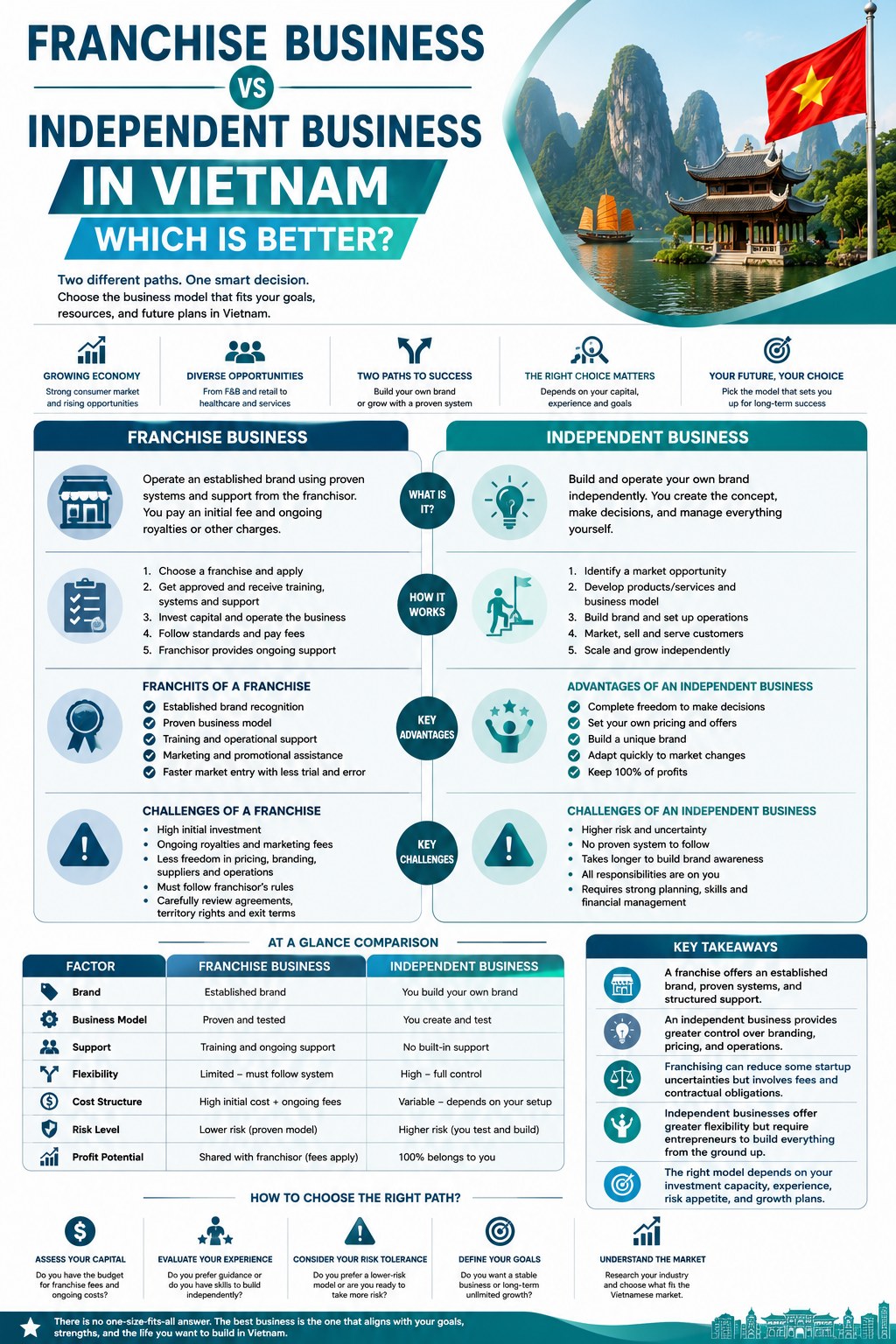
The better model depends on what you value most: structure or freedom, established recognition or complete ownership, guided growth or independent decision-making. Vietnam’s expanding franchise market gives entrepreneurs both options, but the differences become clearer when compared side by side.
| Factor | Franchise Business | Independent Business |
| Brand recognition | Starts with an established brand, helping reduce the time needed to build customer awareness and credibility. | The entrepreneur must create the brand identity, reputation, and customer trust from the beginning. |
| Business model | Uses an established and tested operating framework, reducing the need to develop processes independently. | The owner creates and tests the business model, products, pricing, and operating systems. |
| Investment | Includes franchise fees and potentially ongoing royalties, marketing contributions, and setup costs. | No franchise fees or royalties, but the owner bears the cost of developing the business independently. |
| Control | Franchisees must generally follow the franchisor’s standards and contractual requirements. | Owners have greater freedom over products, pricing, suppliers, branding, and business decisions. |
| Training and support | Franchisors may provide training, marketing, operational guidance, technology, and ongoing support. | The entrepreneur must arrange or develop training, systems, marketing, and operational expertise independently. |
| Risk | Some startup uncertainty is reduced through an established brand and business framework, although financial and operational risks remain. | Greater uncertainty because the concept, market response, and customer acquisition strategy must be tested independently. |
| Growth | Expansion can follow an established system and benefit from recognised branding. | Growth depends entirely on the owner’s ability to develop and scale the business. |
| Flexibility | Less flexibility because franchise agreements and brand standards influence important decisions. | Maximum flexibility to adapt quickly to Vietnamese market preferences and changing customer needs. |
| Best suited for | Entrepreneurs seeking structure, guidance, established branding, and a proven operating framework. | Entrepreneurs with a strong business concept, industry expertise, and confidence in independent decision-making. |
Best Industries for Independent Businesses in Vietnam
Not every business needs a franchise structure to succeed. Vietnam’s entrepreneurial environment creates considerable room for locally developed concepts, particularly where local knowledge, creativity, and flexibility can become competitive advantages.
1. Food & Beverage
Vietnam’s strong food culture creates opportunities for independent cafés, restaurants, bakeries, speciality food concepts, and delivery-first businesses. Local entrepreneurs can adapt menus, pricing, and concepts quickly to regional tastes without following franchise guidelines.
2. Digital & Technology Services
Web development, digital marketing, software services, e-commerce support, and AI-enabled solutions can be started with comparatively flexible business models. Entrepreneurs can build specialised services around the needs of Vietnamese SMEs and growing brands.
3. Tourism & Hospitality
Vietnam’s tourism economy creates opportunities for boutique accommodation, travel experiences, local tour services, and speciality hospitality concepts. Independent operators can differentiate themselves through local knowledge and personalised experiences.
4. Personal & Professional Services
Consulting, recruitment, creative agencies, accounting, education services, and specialised training can also work well independently because expertise and client relationships are often more important than a physical brand network.
These sectors give entrepreneurs room to experiment, adapt quickly, and build a brand around their own understanding of the Vietnamese market.
Best Industries for Franchise Businesses in Vietnam
Some industries benefit particularly well from the structure and recognition that franchising provides. Vietnam’s franchise market already spans healthcare, food and beverage, education, retail, beauty, children’s services, and lifestyle businesses, with more than 310 foreign brands registered as franchising businesses as of September 2023, according to the U.S. Commercial Service.
Invest in Growing Franchise in Vietnam
Join DHI Today1. Healthcare & Wellness
Healthcare is particularly interesting because trust, specialised expertise, and consistent treatment protocols matter. Within this category, hair restoration offers a focused opportunity for entrepreneurs seeking a premium healthcare franchise.
This is where DHI International becomes relevant. DHI’s current franchise programme states that it operates 75 clinics across 45 countries and offers franchise partners training, operational support, marketing resources, proprietary protocols, and its Direct Hair Implantation technique.
For an entrepreneur who wants to enter Vietnam’s healthcare market without developing an entire medical brand from scratch, a specialised DHI franchise can provide a structured route into hair restoration while retaining local business ownership.
2. Food & Beverage
Fast food, cafés, beverages, and casual dining remain major franchise categories. Established brands such as KFC, McDonald’s, Starbucks, Pizza Hut, Domino’s Pizza, and Subway have developed strong market recognition in Vietnam.
3. Education & Children’s Services
Language learning, tutoring, STEM education, and children’s development services offer opportunities for franchise investors because established curricula and operating systems can be valuable.
4. Retail & Convenience
Convenience stores and specialty retail benefit from established supply chains, branding, and standardised operations. Circle K, FamilyMart, and 7-Eleven are examples of international convenience brands operating in Vietnam.
Conclusion
Choosing between a franchise and an independent business in Vietnam ultimately comes down to how you want to build your business. An independent model gives you complete control and room to experiment, while a franchise offers an established framework, brand recognition, training, and operational support.
Neither approach guarantees success. What matters is finding a model that matches your capital, experience, risk tolerance, and understanding of the Vietnamese market.
For entrepreneurs considering healthcare, the decision becomes even more important because clinical expertise and patient trust are central to the business. A specialised franchise such as DHI International offers an alternative to building a hair restoration brand from the ground up, combining its established clinical framework with franchise support and local business ownership.
FAQs
1. Is a franchise business more profitable than an independent business in Vietnam?
Yes, a franchise business can be more profitable than an independent business in Vietnam. An established brand, proven business model, operational support, and customer trust can help entrepreneurs build and grow the business more effectively.
2. What is the biggest advantage of buying a franchise?
The biggest advantage is access to an established business model. Franchisees can benefit from brand recognition, proven processes, training, marketing support, and operational guidance from the franchisor.
3. Can foreigners own a franchise business in Vietnam?
Yes, foreigners can own businesses in Vietnam, subject to applicable investment, registration, ownership, and sector-specific requirements. The exact process depends on the business structure and industry.
4. What industries offer the best franchise opportunities in Vietnam?
Healthcare, food and beverage, education, retail, beauty and wellness, and children’s services offer promising franchise opportunities. The right sector depends on market demand, investment capacity, competition, location, and business expertise.
5. How much investment is typically required for a franchise business?
There is no standard investment amount. Costs vary by brand, industry, location, franchise fee, equipment, staffing, and working capital. Investors should also account for ongoing royalties and marketing contributions.
6. Is starting an independent business riskier than buying a franchise?
Generally, yes. Independent businesses require entrepreneurs to build their brand, systems, and customer base from scratch. Franchises reduce some uncertainty through established processes and support, although financial and operational risks remain.
7. Which business model grows faster in Vietnam?
Neither model guarantees faster growth. Franchises can scale efficiently through established systems and brand recognition, while independent businesses may grow quickly when their concept strongly matches local customer demand.
8. How do I choose the right franchise opportunity?
Evaluate market demand, investment requirements, brand reputation, profitability, training, operational support, territory rights, and scalability. Carefully review the franchise agreement and choose an opportunity that matches your goals and business experience.
9. Is a healthcare franchise a good investment in Vietnam?
Healthcare can be an attractive franchise sector because demand for specialised services continues to grow. However, investors should evaluate regulations, competition, investment requirements, location, and the franchisor’s reputation before making a decision.