
Advantages of Buying a Franchise in Peru Instead of Starting from Scratch
A franchise can give an entrepreneur a head start, but it does not remove the challenges of running a business. In Peru, franchising has been recovering strongly, with food franchises leading the market and service-based concepts also creating new opportunities.
For an investor, the decision is therefore not simply about whether franchising is good or bad. It is about understanding what you gain through an established business model, what you give up in terms of control, and whether the model fits your investment goals. This guide explores both sides so entrepreneurs can make a more informed decision before investing.
Key Takeaways
- Franchising provides an established brand, operating framework, and structured support.
- Independent businesses offer greater control over branding, pricing, and business decisions.
- Peru’s franchise industry has recovered strongly, with food remaining a leading category.
- The right choice depends on capital, experience, risk tolerance, and long-term business objectives.
Understanding the Business Landscape in Peru
Peru’s franchise market is showing renewed momentum, with food franchises continuing to lead because of strong consumer demand and the appeal of established brands. Many food concepts are also adapting to smaller formats and delivery-focused operations, reflecting changing consumer behaviour.
At the same time, franchising extends beyond restaurants. Healthcare, education, beauty, retail, cleaning, specialised services, and other categories provide entrepreneurs with different ways to enter the market. This variety makes Peru attractive for investors, but it also means that choosing the right industry and business model requires careful evaluation.
Peru’s franchise market is showing renewed momentum, with food franchises continuing to lead because of strong consumer demand and the appeal of established brands. Many food concepts are also adapting to smaller formats and delivery-focused operations, reflecting changing consumer behaviour.
At the same time, franchising extends beyond restaurants. Healthcare, education, beauty, retail, cleaning, specialised services, and other categories provide entrepreneurs with different ways to enter the market. This variety makes Peru attractive for investors, but it also means that choosing the right industry and business model requires careful evaluation.
Growth of the Franchise Industry in Peru
Peru’s franchise industry has experienced a strong recovery in recent years, with food franchises remaining particularly prominent. The market has also adapted to changing consumption patterns, including greater emphasis on delivery and smaller-format locations.
This recovery creates opportunities for both established international brands and emerging concepts. For entrepreneurs, the appeal lies in entering a business environment where franchising is already recognised as a viable expansion model. However, market growth alone does not guarantee success. Investors still need to assess local demand, competition, investment requirements, and the strength of the franchisor before choosing an opportunity.
Key Sectors with Strong Franchise Potential
Food remains one of the strongest franchise categories in Peru, supported by consumer demand and established international brands. Beyond food, entrepreneurs can explore opportunities in healthcare, education, beauty and wellness, retail, cleaning, professional services, and other specialised segments.
Healthcare is particularly interesting because specialised services can create focused business opportunities around specific consumer needs. Hair restoration, for example, combines healthcare expertise with a premium service model. For investors, this allows franchising to extend beyond traditional restaurants and retail into specialised businesses where expertise, brand credibility, and operational standards can influence customer decisions.
Why Peru Attracts Entrepreneurs
Peru offers entrepreneurs access to a diverse consumer market and an established commercial ecosystem, while franchising provides a structured route into business ownership. For many investors, the combination can be attractive because they do not have to develop a brand and operating model entirely from scratch.
The country’s franchise market also includes international concepts, giving entrepreneurs opportunities to work with established business systems. At the same time, local market knowledge remains important. Understanding customer preferences, pricing sensitivity, location, competition, and regulatory requirements can determine whether a franchise performs successfully in a particular Peruvian market.
What Makes A Good Franchise?
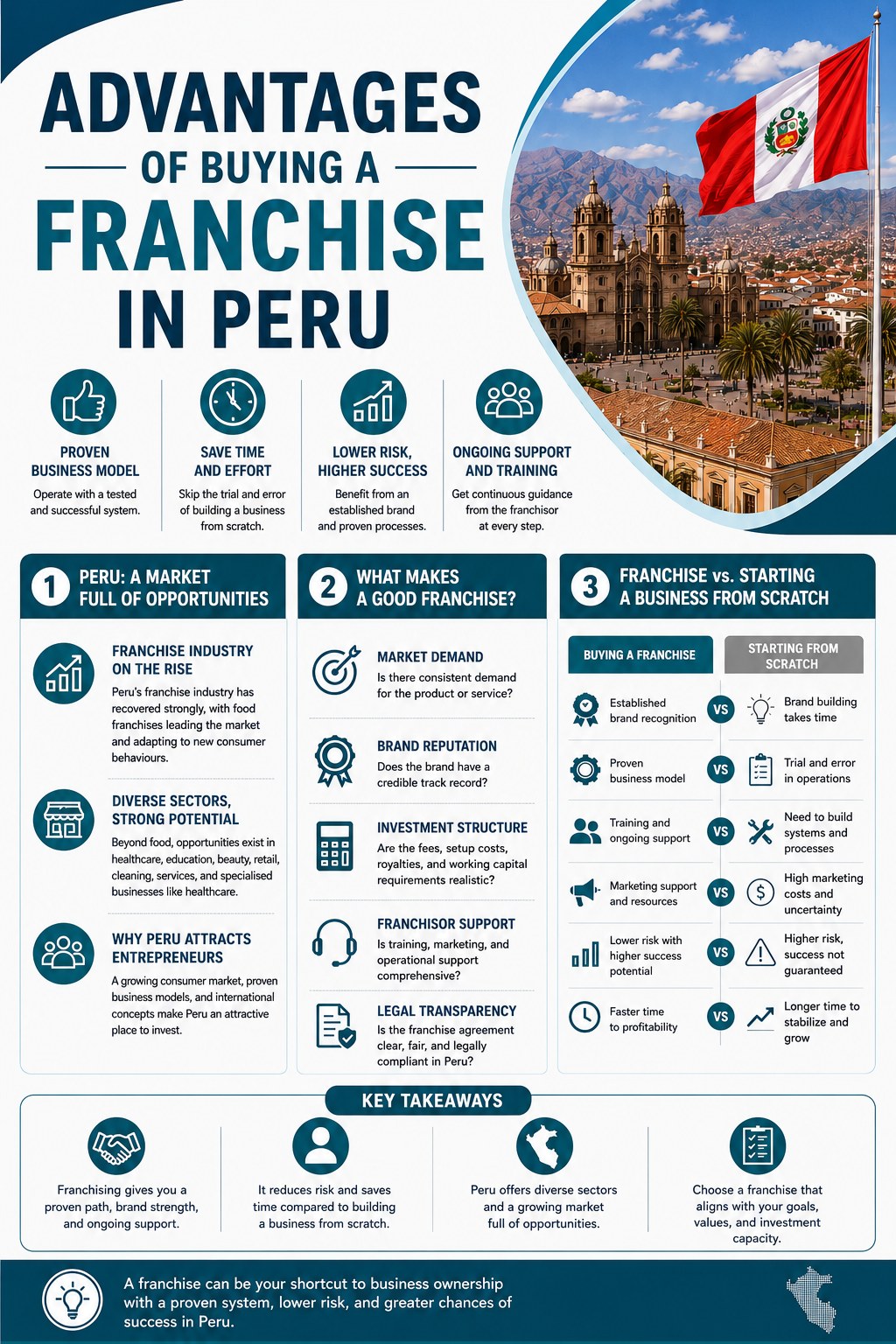
A strong franchise is more than a recognisable name. It should have a business model that makes commercial sense, clear operating systems, and a franchisor capable of supporting its partners. Before investing, consider:
- Market Demand: Is there consistent demand for the product or service?
- Brand Reputation: Does the brand have a credible track record?
- Investment Structure: Are the franchise fee, setup costs, royalties, and working capital requirements realistic?
- Franchisor Support: What training, marketing, technology, and operational assistance are provided?
- Scalability: Can the business expand into additional locations?
- Profitability: Are the expected margins and break-even timeline realistic?
A franchise becomes more attractive when these elements work together rather than relying solely on brand recognition.
Advantages of Franchising
The biggest attraction of franchising is the ability to enter a business with an established framework instead of developing everything independently. This can be especially valuable for entrepreneurs who want structure, guidance, and an existing brand behind their investment.
Key benefits include:
- Established Brand: Customer recognition can make market entry easier.
- Proven Business Model: Operating systems and processes are already developed.
- Training & Support: Franchisees may receive operational, marketing, technical, and management training.
- Marketing Resources: Established brands often provide centralised marketing tools and campaigns.
- Supplier Networks: Franchise systems may offer access to established suppliers and purchasing arrangements.
- Scalability: A standardised model can make expansion into additional locations easier.
These benefits can reduce some of the uncertainty associated with starting a completely new business.
Franchise vs. Starting a Business from Scratch ( Comparison Table)
Choosing between a franchise and an independent business ultimately comes down to how much structure, control, and support you want. A franchise gives entrepreneurs access to an established brand, tested systems, training, and operational guidance, making market entry more structured.
Starting from scratch offers greater freedom. You control the brand, pricing, suppliers, services, and growth strategy, but you also have to develop the business model, build customer trust, and establish operations independently.
| Comparison Factor | Franchise Business | Independent Business |
| Brand recognition | Established | Built from scratch |
| Business model | Proven framework | Developed independently |
| Training & Support | Usually provided | Self-managed |
| Control | Limited by franchise terms | Complete control |
| Initial cost | Franchise and setup costs | Setup and development costs |
| Risk | Structured but not risk-free | Greater uncertainty |
| Scalability | Standardised expansion model | Depends on owner’s strategy |
Industries Where Franchise Business Performs Well in Peru
Peru’s franchise market extends beyond traditional food businesses, with opportunities emerging across healthcare, education, beauty, retail, and essential services. Each sector offers a different investment proposition, allowing entrepreneurs to choose a model based on market demand, expertise, and growth potential.
1. Food & Beverage
Food and beverage remains one of the strongest franchise categories in Peru, covering quick-service restaurants, cafés, bakeries, casual dining, dessert outlets, and delivery-focused concepts. Established franchises can benefit from existing customer recognition, standardised menus, supplier networks, and proven operating systems. Entrepreneurs can also explore smaller-format concepts that require less space and focus on takeaway or delivery. However, location remains critical because foot traffic, rental costs, local competition, and customer preferences can significantly affect performance. For investors, food franchising can be attractive when the brand has strong market recognition, and the business model offers healthy margins alongside manageable operating costs.
2. Healthcare
Healthcare is an increasingly interesting franchise category because entrepreneurs can enter specialised services rather than competing across general medical care. Opportunities can include diagnostic centres, dental clinics, aesthetic healthcare, wellness services, fertility care, and hair restoration clinics. Specialised healthcare businesses can benefit from recurring demand and the importance consumers place on professional expertise and trusted providers. Hair restoration is particularly relevant for investors seeking a focused healthcare model.
DHI International offers a specialised hair restoration franchise, combining its established brand, clinical training, operational guidance, and Direct Hair Implantation technique. This makes healthcare a strong category for entrepreneurs seeking a specialised, differentiated franchise opportunity.
3. Education
Education franchises can cover language schools, tutoring centres, children’s learning programmes, STEM education, test preparation, and professional training. The advantage of choosing an established education franchise is access to structured curricula, teaching methodologies, training systems, and operational processes. This can reduce the time required to develop educational content and business systems independently. Entrepreneurs can also target different age groups, from preschool children to adults seeking professional skills. Location and local demographics remain important, particularly
when choosing between a school-based model and a specialised training centre. A strong franchise brand can also support marketing and parent or student acquisition through established promotional strategies.
4. Beauty & Wellness
Beauty and wellness franchises offer opportunities across salons, skincare, aesthetic treatments, spas, personal care, and specialised wellness services. The sector benefits from recurring consumer spending, particularly when customers return regularly for treatments or maintenance services. Entrepreneurs can choose between broader beauty concepts and specialised models focused on a particular treatment or customer segment. Established franchises can provide standardised service procedures, staff training, branding, equipment guidance, and marketing support.
For investors, the most important considerations include location, customer demographics, treatment pricing, staffing requirements, and competition. A differentiated service offering can help a franchise stand out in Peru’s growing personal care and wellness market.
5. Business & Home Services
Business and home service franchises can provide opportunities in cleaning, maintenance, pest control, logistics, printing, staffing, accounting, property services, and other professional solutions. Many of these businesses address recurring customer requirements, which can support repeat business and longer-term client relationships. Unlike traditional retail concepts, some service franchises can operate with relatively limited storefront requirements, depending on the model.
This may allow entrepreneurs to focus investment on equipment, staff, technology, and customer acquisition. Before choosing a franchise, investors should assess territory availability, staffing requirements, recurring operating costs, demand within the target area, and the level of operational and marketing support provided by the franchisor.
Why DHI Franchise is a Strong Opportunity in Peru
Healthcare franchising gives entrepreneurs an opportunity to enter a sector built around essential and specialised consumer needs. Within this space, hair restoration stands out as a focused business category combining medical expertise, aesthetics, and premium treatment services.
DHI International brings decades of specialised experience in hair restoration and an established franchise framework. Its franchise model provides partners with clinical training, operational guidance, marketing support, standardised protocols, and access to its Direct Hair Implantation technique.
For entrepreneurs in Peru, this creates an opportunity to build a specialised hair restoration business without developing the entire clinical and operational framework independently. The combination of an established international brand, specialised expertise, and structured franchise support makes DHI a strong option for investors exploring healthcare franchising.
Start Franchise Business in Peru
Join DHI TodayConclusion
Franchising can offer Peruvian entrepreneurs a structured path into business ownership, particularly when entering specialised or competitive industries. An established brand, proven systems, training, and operational support can provide advantages that would take considerable time to develop independently.
However, choosing the right franchise still requires careful evaluation of investment, market demand, location, competition, profitability, and franchise terms. Healthcare presents an especially interesting opportunity because demand for specialised services continues to evolve.
Within this sector, DHI International offers entrepreneurs a focused route into hair restoration through its established franchise model, specialised clinical expertise, and international experience. For investors looking to combine healthcare with a specialised, premium service opportunity, a DHI franchise in Peru is worth exploring.
FAQs
1. Is buying a franchise in Peru less risky than starting a business from scratch?
A franchise can reduce some startup uncertainty by providing an established brand, business model, training, and operational support. However, profitability is never guaranteed, and investors still face financial, operational, and market-related risks.
2. How much investment is required to buy a franchise in Peru?
Investment varies by industry, brand, location, franchise fee, equipment, staffing, and working capital. Entrepreneurs should evaluate the complete investment requirement, including ongoing royalties, marketing contributions, operating expenses, and other franchise-related costs.
3. Which industries are most profitable for franchises in Peru?
Food and beverage, healthcare, education, beauty and wellness, retail, and professional services offer attractive franchise opportunities. Profitability depends on market demand, location, operating costs, investment size, brand strength, and effective business management.
4. Can foreigners buy a franchise in Peru?
Yes, foreign investors can explore franchise opportunities in Peru, subject to applicable business registration, investment, tax, employment, and sector-specific requirements. The exact process depends on the business structure, industry, ownership arrangement, and activities involved.
5. What support do franchisors usually provide?
Franchisors may provide brand licensing, initial and ongoing training, operational guidance, marketing resources, technology, site selection assistance, recruitment support, and launch guidance. The exact package varies by franchise, so investors should review the agreement carefully.
6. How long does it take for a franchise to become profitable?
There is no fixed timeframe because profitability depends on investment, location, customer demand, pricing, operating costs, patient or customer volume, and business management.
7. Is a healthcare franchise a good investment in Peru?
Yes, healthcare franchising can be an attractive opportunity in Peru because it combines consistent healthcare needs with growing demand for specialised services.
8. How do I choose the best franchise opportunity in Peru?
Evaluate market demand, total investment, brand reputation, franchise fees, profitability potential, training, operational support, location, competition, scalability, and contractual terms. Choose a franchise that aligns with your capital, experience, business objectives, and long-term growth plans.