Healthcare Franchise Business in Brazil: Costs, Benefits & Opportunities

Healthcare is no longer limited to hospitals and traditional medical practices. In Brazil, growing health awareness, an expanding middle class, and increasing demand for specialised services are creating new opportunities for healthcare entrepreneurs. From diagnostic centres and dental clinics to aesthetic medicine and hair restoration, specialised healthcare businesses are gaining attention.
For entrepreneurs, a healthcare franchise offers another way to enter this growing market. Instead of building a healthcare brand, systems, and customer base from scratch, investors can work with an established franchise model and receive structured support. This guide explores the costs, benefits, opportunities, and working model of healthcare franchises in Brazil, helping prospective investors understand what the market can offer.
Key Takeaways
- Brazil’s large population creates substantial demand for accessible and specialised healthcare services.
- Healthcare franchises can offer established brands, structured operations, training, and business support.
- Opportunities exist across diagnostics, dental care, rehabilitation, aesthetics, wellness, and hair restoration.
- Specialised healthcare services can provide premium business opportunities within the wider healthcare market.
- Investors should assess franchise costs, market demand, regulatory requirements, brand reputation, and ongoing support before investing.
What Is a Healthcare Franchise?
A healthcare franchise allows an entrepreneur to operate a medical or healthcare-focused business under an established brand and business system. Rather than developing every process independently, the franchisee receives access to the franchisor’s operating framework, branding, training, and agreed support.
Healthcare franchises can cover a wide range of services, including diagnostic laboratories, dental clinics, physiotherapy centres, aesthetic medicine, wellness services, and specialised hair restoration clinics. The franchise owner generally manages the commercial and operational side, while qualified healthcare professionals provide clinical services in accordance with Brazilian regulations.
For entrepreneurs, this model offers a structured route into healthcare while allowing them to build a locally operated business under an established brand.
Why Invest in a Healthcare Franchise in Brazil?
Brazil’s healthcare market presents an opportunity where large-scale demand meets an increasingly specialised consumer base. People are paying greater attention to preventive care, personal wellbeing, aesthetics, and specialised treatments, creating room for businesses that can deliver focused healthcare services.
For entrepreneurs, this creates opportunities beyond conventional medical clinics. A well-positioned franchise can combine an established business model with local market demand, helping investors enter healthcare with greater structure and support.
Invest in Healthcare Franchise in Brazil
Join DHI TodayGrowing Healthcare Market
Brazil’s large population and extensive healthcare needs create a broad customer base for medical and wellness businesses. As healthcare expectations evolve, opportunities are emerging across diagnostics, dental services, rehabilitation, aesthetics, and other specialised areas.
Increasing Demand for Specialized Medical Services
Patients are increasingly seeking specialised services rather than relying solely on general healthcare providers. This creates opportunities for focused businesses offering areas such as fertility care, diagnostics, rehabilitation, aesthetic medicine, and hair restoration.
Expanding Middle-Class Population
As household purchasing power develops, more consumers are willing to spend on healthcare services that improve their quality of life. This creates opportunities for private healthcare businesses offering convenient, specialised, and premium services.
Government Support & Private Healthcare Growth
Brazil’s healthcare ecosystem includes both a large public healthcare system and an established private healthcare sector. Continued private investment and the expansion of specialised services are creating opportunities for healthcare businesses that can meet changing patient expectations.
How the Healthcare Franchise Industry Works in Brazil
A healthcare franchise generally begins with selecting a suitable brand and evaluating its investment requirements, business model, territory, and support structure. Once the franchise agreement is established, the investor works with the franchisor to prepare the business for launch.
The process may include site selection, clinic design, equipment planning, recruitment, staff training, marketing, and operational preparation. The franchisee manages the business according to the franchisor’s standards, while qualified professionals deliver healthcare services in compliance with applicable Brazilian requirements.
This structure allows entrepreneurs to focus on building the local business while benefiting from an established healthcare model. However, franchise terms, costs, professional requirements, and regulatory obligations can vary considerably by healthcare segment and should be reviewed before investment.
Healthcare Franchise Business Costs in Brazil
Starting a healthcare franchise requires more than paying the franchise fee. The total investment usually includes several expenses that should be assessed together before making a decision. Understanding these costs helps investors prepare realistic budgets and avoid unexpected financial pressure after launch.
Initial Franchise Fee
The initial franchise fee is the amount paid to the franchisor for the right to operate under its brand and business system. It can provide access to established branding, operating processes, training, intellectual property, and other franchise resources. The amount varies significantly depending on the healthcare segment, brand reputation, territory, and scale of the business. Investors should look beyond the headline franchise fee and understand exactly what it includes. Some brands may bundle training or initial support into the fee, while others may charge separately for specific services. Reviewing the franchise agreement carefully will help determine the actual upfront financial commitment.
Clinic Setup & Infrastructure Costs
A healthcare clinic needs an environment that supports both patient comfort and professional service delivery. Setup expenses can include commercial premises, interior fit-out, reception areas, consultation rooms, treatment spaces, electrical and plumbing work, signage, safety systems, and other infrastructure requirements. The total cost depends heavily on the clinic’s size, location, healthcare specialty, and franchisor specifications. A premium medical facility may require considerably more investment than a smaller specialised centre. Entrepreneurs should also consider rent deposits, permits, utilities, and pre-opening expenses when calculating the required capital. Planning these costs carefully can prevent delays and ensure the clinic is ready to operate efficiently from launch.
Medical Equipment Investment
Medical equipment can represent a significant part of the investment in a healthcare franchise. The requirements depend on the service offered and may include diagnostic equipment, treatment devices, surgical instruments, patient monitoring systems, sterilisation equipment, and specialised technology. Hair restoration, dental, diagnostic, and fertility clinics, for example, each require different equipment and technical infrastructure. Investors should understand whether equipment must be purchased through approved suppliers or specified by the franchisor. It is also important to account for installation, maintenance, upgrades, and replacement costs. Choosing reliable equipment can support service quality, clinical efficiency, and patient confidence while protecting the clinic’s long-term operating capability.
Staffing & Training Expenses
Healthcare businesses depend heavily on qualified professionals and well-trained support teams. Staffing costs may include doctors, nurses, technicians, therapists, administrative employees, reception staff, and other personnel required for the chosen healthcare service. Beyond salaries, investors should budget for recruitment, onboarding, professional development, and ongoing training. A franchise may provide specialised training for clinical and administrative teams, but additional local training requirements can still apply. Staffing requirements can also vary according to the clinic’s operating hours and patient volume. Building the right team is particularly important in healthcare because service quality, patient experience, and compliance depend heavily on employees having the appropriate skills and responsibilities.
Marketing & Brand Promotion
A new healthcare clinic needs visibility before it can build a steady patient base. Marketing expenses may include digital advertising, local campaigns, social media, website development, search marketing, promotional materials, launch activities, and patient communication. Franchisees may benefit from national or international brand campaigns, but local marketing remains important for attracting patients within the clinic’s territory. Some franchise agreements also include ongoing marketing contributions or require franchisees to follow specific brand guidelines. Investors should therefore clarify which promotional activities are covered by the franchisor and which must be funded locally. A well-planned launch campaign can help establish awareness and begin building patient relationships from the early stages.
Ongoing Royalty & Operational Costs
The financial commitment doesn’t end once the healthcare franchise opens. Depending on the franchise agreement, ongoing costs may include royalties, marketing contributions, technology fees, staff salaries, rent, utilities, equipment maintenance, medical supplies, insurance, and other operating expenses. These costs directly affect the clinic’s margins, so investors should understand them before signing the agreement. It is also useful to estimate monthly expenses under different patient-volume scenarios rather than relying only on projected revenue. A clear understanding of recurring costs allows entrepreneurs to calculate potential profitability, working capital requirements, and the time needed to reach break-even more realistically.
Benefits of Investing in a Healthcare Franchise
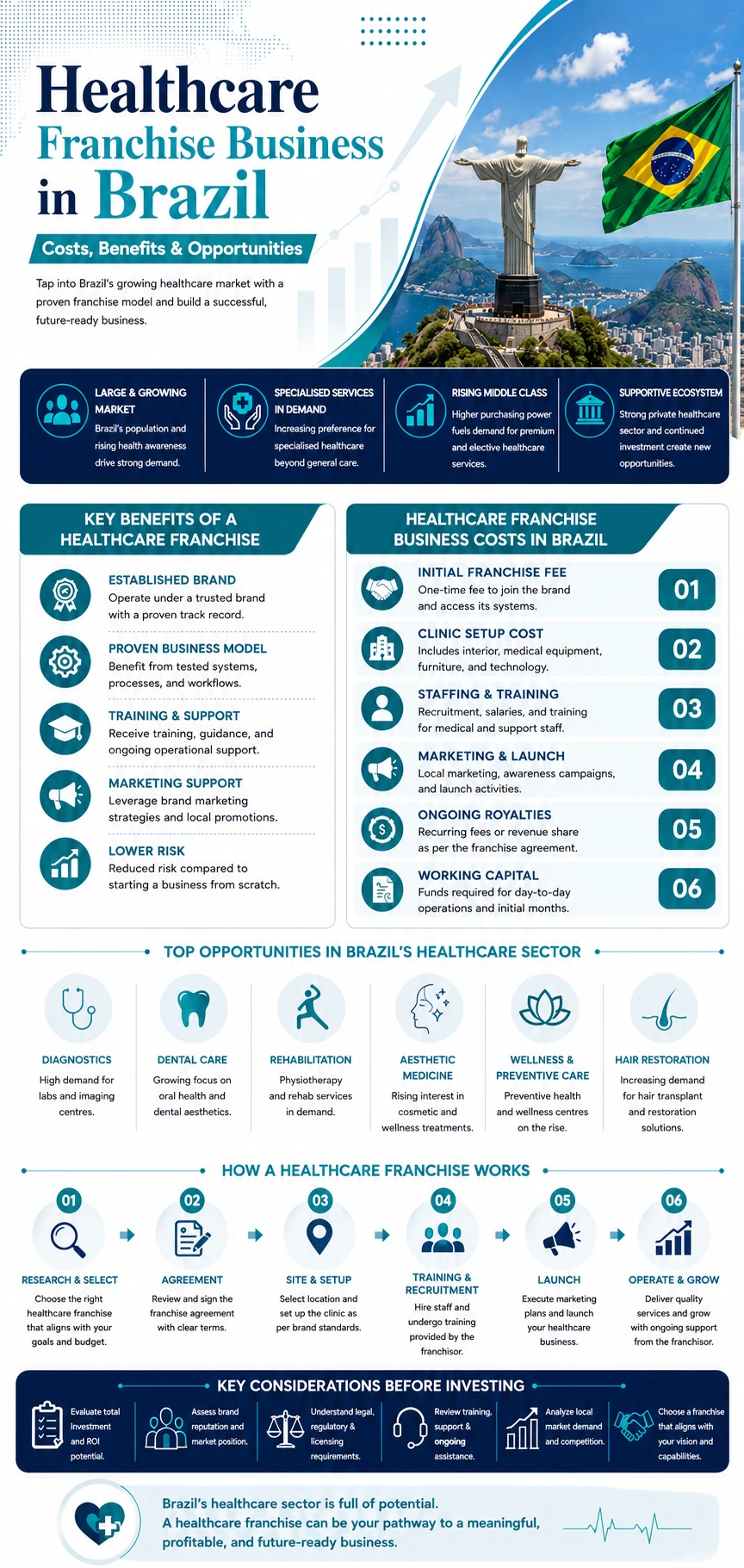
Healthcare franchising offers something that independent medical businesses often have to build over many years: an established framework for delivering and marketing specialised services. For entrepreneurs, this can make entering the healthcare sector more structured while providing access to resources developed by an experienced franchisor.
Established Brand Recognition
Building trust is especially important in healthcare because patients want confidence in the provider they choose. An established franchise brand can give a new clinic immediate recognition that an independent business may take years to develop. Patients may already be familiar with the brand, its services, or its reputation in other markets. This recognition can support early customer acquisition and make local marketing more effective. For entrepreneurs, the advantage goes beyond having a familiar name on the clinic. An established brand may also provide standardised branding, communication guidelines, and patient-facing materials that create a consistent experience across locations.
Proven Business Model
Starting an independent healthcare business means developing everything from operational processes and customer acquisition strategies to pricing structures and service workflows. A franchise provides a framework that has already been developed and refined by the franchisor. This can include clinic processes, service standards, staffing structures, marketing approaches, and performance guidelines. Entrepreneurs can therefore spend more time managing the local business rather than testing every aspect from the beginning. A proven model does not eliminate business risk, but it can reduce some of the uncertainty associated with creating a new concept. This makes franchising particularly attractive to entrepreneurs entering healthcare for the first time.
Comprehensive Training & Operational Support
Healthcare franchising can provide entrepreneurs with access to expertise that would otherwise take considerable time and resources to develop independently. Depending on the brand, support may include clinical training, administrative training, recruitment guidance, clinic setup, operational procedures, marketing assistance, and ongoing business consultation. This support can be especially valuable in specialised healthcare segments where maintaining consistent standards is essential. Franchisees can also benefit from established processes for patient management, staff coordination, and day-to-day operations. Before investing, however, entrepreneurs should examine exactly what support is included, how long it continues, and whether additional services carry separate costs.
Faster Return on Investment
A franchise can potentially shorten the path towards profitability by combining an established brand with an existing business model, operational systems, and marketing resources. Instead of spending significant time developing market awareness from zero, franchisees can begin with a recognised concept and structured launch process. However, faster ROI should never be treated as guaranteed. Results depend on location, patient demand, pricing, operating costs, staffing, investment size, and business management. Investors should therefore assess realistic revenue projections and break-even timelines before committing capital. The value of franchising lies in creating a stronger starting framework, not promising a predetermined financial return.
Higher Customer Trust
Trust can directly influence healthcare decisions. Patients are more likely to consider providers that demonstrate professional expertise, consistent standards, and a credible track record. An established healthcare franchise can help build this confidence through recognised branding, standardised procedures, trained professionals, and established patient service systems. This can be particularly valuable when launching specialised services where patients may carefully research providers before making a decision. A trusted franchise brand does not replace clinical quality, but it can create a stronger foundation for patient acquisition. Over time, delivering consistent experiences can help the clinic strengthen its local reputation through referrals, reviews, and returning patients.
Marketing & Technology Support
Healthcare businesses increasingly depend on digital marketing and technology to attract patients, manage enquiries, and deliver a smoother customer experience. Franchisees may benefit from established marketing strategies, digital resources, brand campaigns, patient communication systems, and technology platforms provided by the franchisor. Depending on the franchise, support can also extend to website development, social media, lead management, analytics, and promotional campaigns. This allows entrepreneurs to benefit from resources that would otherwise require separate teams or external agencies. For investors, it is worth checking whether technology and marketing support are included within the franchise arrangement or require additional fees before calculating the overall investment.
Profitable Healthcare Franchise Opportunities in Brazil
Brazil’s healthcare market offers opportunities across both essential and specialised services. For entrepreneurs, the strongest models are those that combine consistent demand with specialised expertise and the ability to build long-term patient relationships. Here are five healthcare franchise opportunities worth considering.
Hair Transplant Clinics
Hair restoration is becoming an increasingly specialised segment of aesthetic healthcare, creating opportunities for clinics that offer advanced and medically supervised solutions. Entrepreneurs can enter this market through hair transplant and restoration clinics that cater to patients seeking long-term solutions. The premium nature of these procedures can also create attractive revenue potential when supported by the right location, clinical expertise, and patient experience.
DHI International is particularly relevant for investors exploring this segment. The brand has specialised exclusively in hair restoration since 1970 and operates across 75 clinics in 45 countries, according to its official information. Its franchise model offers entrepreneurs an established framework for entering the specialised hair restoration market.
Eye Care Clinics
Eye care remains an essential healthcare service, with demand spanning routine examinations, vision correction, cataract care, and other specialised treatments. Brazil’s large population creates a broad potential patient base, while greater awareness of preventive eye health encourages consumers to seek professional care earlier. Entrepreneurs can explore opportunities through ophthalmology clinics, optical services, diagnostic centres, and specialised vision-care businesses. The sector can also benefit from recurring consultations and referrals, particularly when clinics establish relationships with local physicians and communities.
For investors, the key is selecting a business model that combines qualified professionals, appropriate technology, accessible locations, and strong patient service. Healthcare franchises can provide additional operational structure for entrepreneurs entering this specialised field.
IVF & Fertility Clinics
Fertility care represents a specialised healthcare opportunity supported by growing awareness of reproductive health and advances in assisted reproductive technology. Couples are increasingly seeking professional guidance for fertility challenges, creating demand for services ranging from initial consultations and fertility assessments to IVF and related treatments. For entrepreneurs, this is a premium segment that requires significant clinical expertise, specialised equipment, qualified professionals, and strict regulatory compliance.
However, its specialised nature can also create a differentiated market position compared with general healthcare businesses. Investors considering fertility franchises should evaluate the franchisor’s clinical capabilities, technology, reputation, training, and patient support systems carefully before committing to this highly specialised healthcare model.
Dental Clinics
Dental care offers one of the broadest healthcare franchise opportunities because demand extends across preventive, restorative, orthodontic, and cosmetic treatments. Consumers require regular consultations throughout their lives, while growing interest in smile aesthetics has expanded the market beyond basic oral healthcare. Entrepreneurs can explore dental franchise models offering general dentistry, orthodontics, implants, cosmetic dentistry, or specialised treatments. The recurring nature of dental consultations and treatments can support predictable patient relationships when a clinic delivers consistent service and quality care.
For investors, location, practitioner availability, equipment requirements, brand reputation, and patient acquisition costs are important considerations. A recognised franchise can provide operational and marketing support while allowing entrepreneurs to build a local healthcare business.
Home Healthcare Services
Healthcare doesn’t always need to happen inside a clinic. Home healthcare services are becoming increasingly relevant as families look for professional support for elderly relatives, patients recovering from procedures, and individuals requiring ongoing assistance. Business opportunities can include nursing care, rehabilitation support, home-based medical assistance, and personal care services. The model can appeal to entrepreneurs because it requires less dependence on traditional clinic infrastructure while addressing a meaningful and recurring healthcare need.
However, success depends heavily on qualified staff, reliable scheduling, patient safety, and strong service management. Investors should therefore evaluate training, staffing systems, regulatory compliance, and franchisor support before choosing a home healthcare franchise.
Steps to Start a Healthcare Franchise in Brazil
Turning a healthcare franchise idea into an operating business requires careful planning. The process involves more than selecting a brand and securing premises, particularly because healthcare businesses must meet professional and regulatory requirements.
- Research the Market: Identify healthcare needs, target patients, competition, and suitable locations.
- Compare Franchise Models: Evaluate investment requirements, franchise fees, support, brand reputation, and revenue potential.
- Review the Franchise Agreement: Understand royalties, territory, renewal terms, responsibilities, and exit conditions before signing.
- Plan the Facility: Work with the franchisor on location, clinic design, equipment, staffing, and operational requirements.
- Complete Training & Setup: Prepare clinical and administrative teams, complete required registrations, implement systems, and prepare for launch.
- Launch & Build Demand: Use the franchisor’s marketing resources alongside local patient acquisition strategies to establish the clinic and develop long-term customer relationships.
Start Franchise Business in Brazil
Join DHI TodayWhy Hair Transplant Franchises Are Emerging as a High-Growth Opportunity
Healthcare investment is increasingly moving toward specialised services, and hair restoration sits at an interesting intersection of medical expertise, aesthetics, and personal confidence. As consumers become more aware of advanced restoration techniques, specialised clinics have an opportunity to serve a premium segment rather than competing solely on conventional healthcare services.
For entrepreneurs, the franchise model can make this opportunity more structured. DHI International brings more than five decades of hair restoration experience, with its Direct Hair Implantation technique launched in 2005 and a global network spanning 75 clinics across 45 countries. DHI also states that its procedures are performed by trained MD dermatologists and supported by established protocols and specialised training. For investors seeking a focused healthcare business, this combination of specialised expertise, brand recognition, and an established operating framework makes hair restoration a compelling segment to explore in Brazil.
Conclusion
Brazil’s healthcare sector offers entrepreneurs several paths to build a specialised business, from dental and eye care to fertility, home healthcare, diagnostics, and hair restoration. The right opportunity depends on investment capacity, local demand, professional requirements, and the level of support available from the franchisor.
For investors looking beyond traditional healthcare models, hair restoration presents a particularly focused opportunity. DHI International combines decades of specialised experience with its proprietary DHI technique, structured protocols, and international presence. For an entrepreneur seeking to enter Brazil’s expanding healthcare and aesthetic market, a specialised hair restoration franchise can provide a differentiated business proposition with an established framework behind it.
FAQs
How much does a healthcare franchise cost in Brazil?
The cost varies by healthcare sector, brand, location, clinic size, equipment, staffing and franchise fees. Entrepreneurs or investors should also budget for marketing, working capital, licensing and ongoing operational expenses before considering the total investment.
Which healthcare franchise has the highest growth potential?
Specialised healthcare models such as hair restoration, diagnostics, dental care, fertility services and home healthcare offer strong growth potential. Among these hair restoration offers an attractive opportunity due to its specialised nature and premium service positioning.
Can foreign investors own healthcare franchises in Brazil?
Yes, foreign investors can establish healthcare franchise businesses in Brazil, subject to applicable ownership, registration, professional and regulatory requirements. The specific requirements may vary depending on the healthcare service and business structure.
What licenses are required to open a healthcare franchise?
Requirements vary according to the healthcare service, location, and professionals involved. Investors may need business registrations, health authority approvals, operating permits and appropriately licensed healthcare professionals to provide clinical services.
Why are hair transplant franchises becoming popular in Brazil?
Hair restoration is gaining attention as consumers become more aware of advanced transplant techniques and increasingly invest in aesthetic healthcare. Specialised clinics can offer premium treatment while benefiting from growing interest in professional long-term hair restoration solutions.
What factors should I consider before buying a healthcare franchise?
Study and evaluate the market demand, total investment, franchise fee, brand reputation, clinical expertise, training, operational support, regulatory requirements, location, and expected essentials before making your investment decision.