
Hair fall is common in both men and women, but excessive hair fall can easily affect your appearance and confidence. Noticing hair strands on your pillow, in the shower drain, or an increase in scalp visibility can be frustrating.
If you are wondering how to stop hair fall, the first step is to understand why it is happening. Hair fall can be caused by many factors, including genetics, stress, nutritional deficiencies, hormonal changes, and scalp conditions. While some types of hair fall are temporary, other hair fall problems may require medical and professional treatment.
Early diagnosis plays an important role in managing hair loss and finding the right solution. From improving your hair care routine and correcting nutritional deficiencies to exploring medical treatments, there are multiple ways to manage hair loss. This guide will explain to you the common causes of hair fall, practical prevention tips, and treatment options that can help support healthier hair.
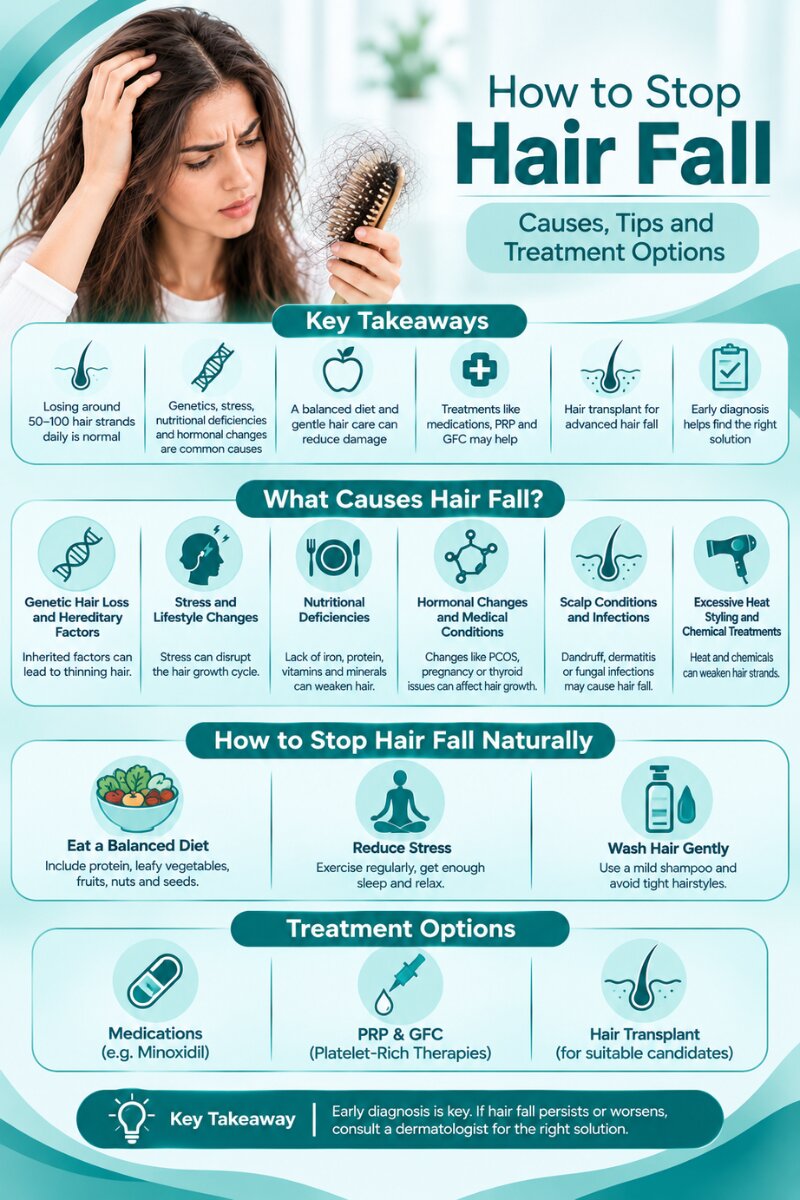
Key Takeaways
- Losing around 50 – 100 hair strands daily is generally considered normal.
- Genetics, stress, nutritional deficiencies, and hormonal changes are common causes of hair fall.
- A balanced diet and gentle hair care routine can help reduce preventable hair damage.
- Treatments such as medications, PRP, and GFC may help manage certain types of hair fall.
- Hair transplant may be considered for suitable candidates with advanced or permanent hair fall.
- Early diagnosis helps identify the cause and determine the most appropriate treatment.
What Causes Hair Fall?
Hair fall is a natural process of the hair growth cycle, with normally 50-100 strands shedding each day, according to the American Academy of Dermatology (AAD). But if there is excessive hair fall and slow growth, it can be a problem, as it can decrease hair density and may lead to baldness. Understand the problems given below, and by doing that, you can identify what problem you and your hair have:
Genetic Hair Loss and Hereditary Factors
One of the most common causes of hair loss is genetics. Also known as androgenetic alopecia, this can affect hair follicles that are sensitive to certain hormones. Over time, the hair follicles will shrink and produce thinner and shorter hairs.
Men often suffer from hair loss at the front of the hairline or crown. Women often suffer from thinning hair across the top of their head.
Concerned About Hair Fall?
Book Your Appointment Now!Stress and Lifestyle Changes
Stress can disrupt the natural hair growth cycle. Major life changes, illness, surgery, sudden weight loss, or ongoing stress can cause telogen effluvium.
This causes more hair follicles to go into the resting phase. This can cause you to see more hair fall. You may start to see more hair fall 2-3 months after the stressful incident.
In many cases, stress-related hair fall will improve once the issue is addressed. However, ongoing or recurring hair fall should be seen by a specialist.
Nutritional Deficiencies
Hair follicles need the right amount of nutrients to grow. A poor diet lacking in essential nutrients can cause issues. Some common nutritional causes include:
- Iron deficiency – Lack of iron can cause issues with the supply of oxygen to tissues, including hair follicles.
- Protein deficiency – Hair is mainly made from keratin (a protein). So it is important to eat enough protein.
- Vitamin D deficiency – Low vitamin D has been linked to certain types of hair fall.
- Zinc deficiency – Zinc helps with normal growth and repair of tissues, including hair follicles.
It is not advised to take supplements if you do not have a deficiency. Too much of certain vitamins/minerals can cause hair fall.
Hormonal Changes and Medical Conditions
Changes in your hormones can affect hair growth. Women can suffer from increased hair fall due to PMOS/PCOD, childbirth, menopause, or other hormonal changes. Men are sensitive to DHT (a hormone derived from testosterone), which plays a role in hereditary patterned hair loss. Certain autoimmune conditions, medications, and treatments can also affect hair growth. It is important to identify the cause.
Scalp Conditions and Infections
A healthy scalp is important for normal hair growth. Scalp conditions such as dandruff, seborrheic dermatitis, psoriasis, and fungal infections can cause irritation, itchiness, and inflammation.
Some infections can also cause damage to hair follicles and cause temporary or severe permanent hair loss. If you are suffering from ongoing issues such as itchiness, redness, flaking, or bald patches, then see a dermatologist.
Excessive Heat Styling and Chemical Treatments
Using heated tools such as straighteners, curling irons, blow dryers, and chemicals can cause damage to the hair shaft. Overheating and harsh chemicals can cause dryness, breakage, and split ends.
Wearing tight hairstyles such as ponytails, braids, and buns can cause ongoing pressure to the hair follicles. This can cause traction alopecia.
Reducing these activities can help protect your current hair.
How to Stop Hair Fall Naturally
Using natural hair care methods can help keep your scalp healthy and reduce damage. However, it may not help if you suffer from genetic hair loss or an underlying medical issue.
Some tips include:
- Balanced diet – Eat plenty of protein, leafy vegetables, fruit, nuts, and seeds.
- Reduce stress – Exercise regularly, get enough sleep, meditate, and relax.
- Wash your hair regularly – Wash with a suitable shampoo for your scalp type.
- Avoid crash diets – Losing weight can cause excessive hair fall.
- Water – It is very important to drink at least 8 glasses of water every day.
Natural remedies may not help completely. It is important to find out the cause.
What Are the Best Hair Care Tips to Prevent Hair Fall?
Making some small changes to your hair care routine can help prevent unnecessary damage to your hair. Some tips include:
- Use a gentle shampoo – Use a shampoo suitable for your scalp type to avoid leaving your hair too dry.
- Use conditioner – Apply conditioner to the mid-lengths to reduce tangles, dryness, and breakage.
- Avoid using too much heat – Reduce the use of straighteners, curling irons and hot blow dryers.
- Avoid tight hairstyles – Hairstyles which put pressure on your roots can cause damage to the hair follicles.
- Brush gently – Use a wide-toothed comb. Avoid tugging your hair when it is wet.
- Avoid using too many chemicals – Colouring, bleaching and straightening can cause damage.
- Avoid unnecessary supplements – Only take vitamins and minerals if needed and ideally after medical advice.
These can help keep your hair in good condition. However, they cannot stop all hair fall. If you are suffering from ongoing thinning, then see a hair specialist.
Take the First Step Towards Healthier Hair!
Book an AppointmentWhat Are the Treatment Options for Hair Fall?
Depending on the cause, severity and condition of your hair follicles, there are various treatments available. Some people may benefit from medications whilst those with severe hair loss may require hair restoration treatments. Common treatments include:
Medication
Medications can help treat certain types of hair loss. The two most common medications are:
- Minoxidil: This can be used topically to help stimulate hair growth and reduce hair fall for suitable patients. It can be used by both men and women.
- Finasteride: This can be used orally to reduce conversion of testosterone to DHT. It is mainly prescribed for male pattern hair loss and may not be suitable for everyone.
Minoxidil can take around 6-12 months to show any noticeable difference. Ongoing use is generally required.
These should only be used after speaking to a medical professional.
PRP Treatment for Hair Loss
PRP (platelet-rich plasma) is a non-surgical treatment. It uses components from your own blood to help with hair growth.
A sample of your blood will be taken and spun in a centrifuge to separate the platelet-rich plasma. This will then be injected into selected areas of the scalp.
Platelets contain growth factors which help repair tissue. PRP aims to help the hair follicles. A systematic review (2024) looked at 9 studies with 291 participants and found PRP may help male pattern hair loss.
However, the treatment varies, so results can vary (Journal of Cosmetic Dermatology).
Growth Factor Concentrate (GFC) Treatment
GFC (growth factor concentrate) is another non-surgical treatment. It uses components from your blood to create a concentrated solution of growth factors. This is then applied to selected areas of the scalp.
GFC may be an option for those suffering from early thinning. However, there is limited evidence available.
A hair specialist can help identify if this treatment would be suitable for you.
Regenerative Treatments for Hair Thinning
Regenerative treatments aim to help with the scalp and improve the condition of weak hair follicles. Some treatments available from hair restoration clinics include Activa Regenera and Exosome Hair Therapy.
These treatments differ from traditional medications and hair transplants. They can vary in terms of how they work and the evidence.
Not all emerging treatments have the same level of evidence. A 2025 consensus statement from the Association of Cutaneous Surgeons of India highlighted the importance of carefully assessing the safety and effectiveness of emerging regenerative treatments
Discuss with your specialist what the expected benefits, limitations, and evidence are.
Hair Transplant for Advanced Hair Loss
If you are suffering from hair loss and certain areas of your scalp have thinned significantly or permanently, then a hair transplant may be an option.
This is a surgical hair restoration treatment where healthy hair follicles are taken from a donor site (usually the back/sides of the head) and implanted into areas of hair loss.
DHI (direct hair implantation) is a hair transplant technique used by DHI Global Medical Group. Specialised instruments are used to implant individual hair follicles. This allows the surgeon to control the angle, direction, and depth.
This treatment is generally suitable for candidates who have enough donor hair. A detailed consultation would be required to assess how much your hair is falling out, how much donor hair you have, the condition of your scalp, and what results you can expect.
A hair transplant will not stop future hair loss from areas not treated. A long-term hair restoration plan may be required, including medical treatments.
When Should You Consult a Hair Specialist?
Occasional hair shedding is normal, but certain changes may indicate an underlying hair or scalp condition that needs attention. You should consider consulting a hair specialist if you notice –
- Sudden or excessive hair shedding that continues for several weeks.
- A gradually receding hairline or thinning crown.
- Visible bald patches or uneven hair fall.
- Persistent scalp itching, redness, irritation, or scaling.
- Hair thinning accompanied by hormonal changes or other health concerns.
- No improvement despite making changes to your hair care routine.
A specialist may examine your scalp, review your medical history, and recommend blood tests or other investigations if required. Early diagnosis can help identify the cause and prevent further progression in certain types of hair fall.
How Long Does It Take to Stop Hair Fall?
The time it takes to reduce your hair fall will depend on the cause, severity, and treatment. Stress-related hair fall may improve gradually once the cause has been addressed. However, it may take several months to see a difference in the density of your hair.
Medications such as minoxidil may take 6-12 months to show any improvement. PRP and GFC may also take several sessions to see any improvement.
Hair transplant results can take time. Initially, the newly implanted hair may fall out; however, you should start to see improvements over several months. Results can take around 12 months or longer.
There is not a set time frame. Following professional advice and attending regular follow-ups can help monitor your progress.
Find Out What’s Causing Your Hair Fall
Schedule Your ConsultationConclusion
Understanding how to stop hair fall starts with identifying its cause. Genetics, stress, nutritional deficiencies, hormonal changes, and scalp conditions can all affect hair growth differently.
While a balanced diet and proper hair care can help maintain healthy hair, persistent hair fall may require medical attention. Treatments such as medications, PRP, GFC and hair transplantation offer different approaches depending on the condition and individual requirements.
If you are experiencing continuous hair thinning or excessive shedding, consult a hair specialist to understand your options. With the right diagnosis and treatment plan, you can take informed steps towards healthier hair.
FAQs
1. Does oiling help stop hair fall?
Oiling can help condition the hair, reduce dryness, and improve manageability. However, it does not treat genetic hair fall or reverse damage to hair follicles.
2. Can stress-related hair fall be reversed?
Yes, stress-related hair fall, particularly telogen effluvium, is often temporary. Once the underlying stress or triggering condition is addressed, hair growth usually begins to recover. However, visible improvement may take several months.
3. Which treatment is best for hair fall?
The best treatment depends on the cause and severity of hair fall. Medications, PRP, GFC, and hair transplantation may be considered for different conditions. A specialist can recommend the most suitable option after evaluating your scalp and hair.
4. Can hair grow back after excessive hair fall?
Yes, hair can grow back after excessive shedding, especially when the cause is temporary, such as stress or nutritional deficiency. However, regrowth depends on whether the hair follicles remain healthy and functional.
5. Does changing your lifestyle reduce hair fall?
A balanced diet, regular exercise, adequate sleep, and stress management can support healthy hair growth. These habits may help reduce hair shedding caused by nutritional or lifestyle-related factors, but they cannot reverse every type of hair fall.
6. How can I prevent hair fall in women and men?
Maintaining a balanced diet, avoiding excessive heat styling, managing stress, and following a suitable hair care routine can help minimise preventable hair damage. If hair thinning continues, seek professional advice to identify the underlying cause.