Hair Transplant for Different Hair Types: Curly, Coily, Fine, and Thick Hair Considerations
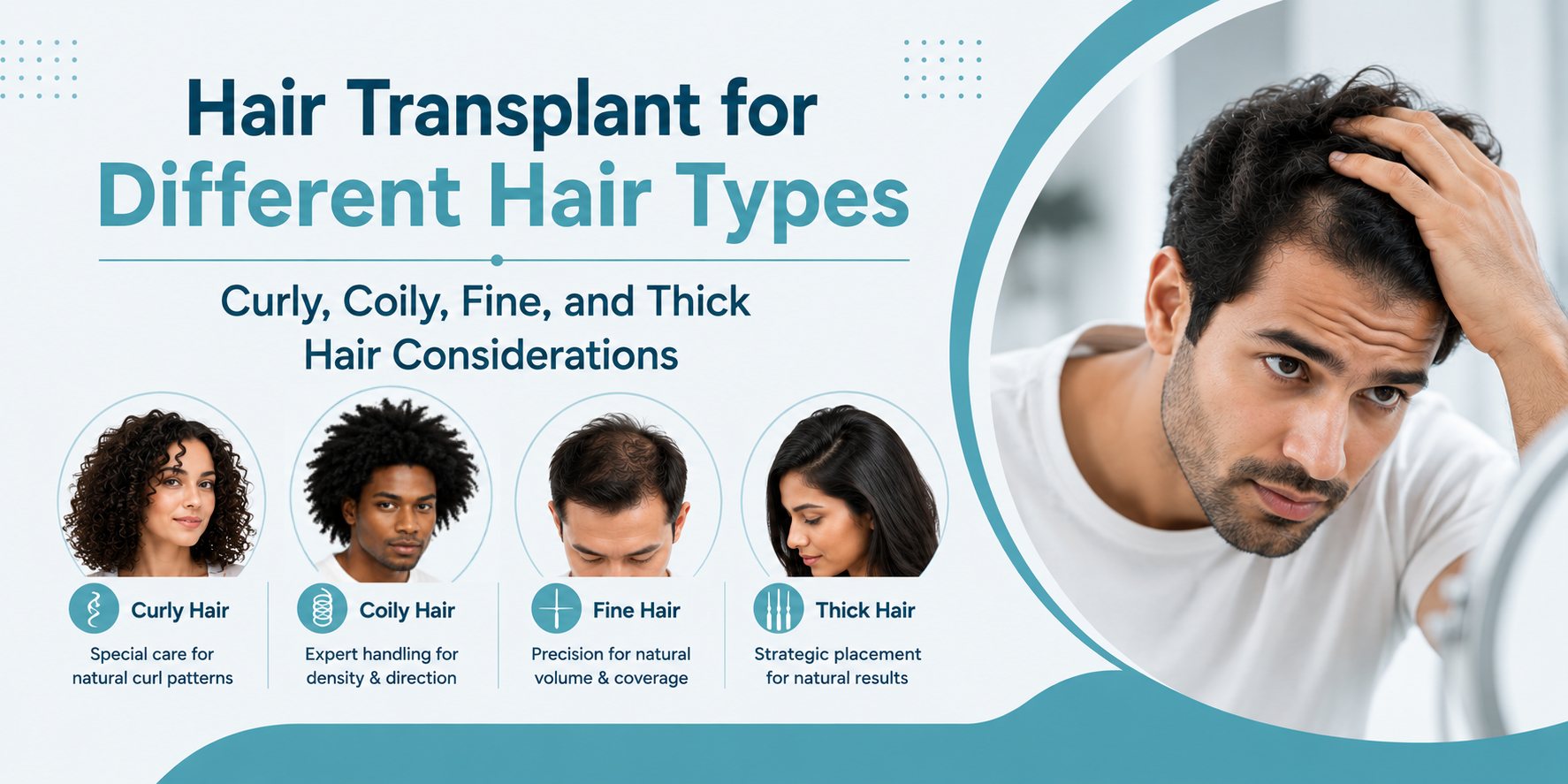
Hair texture plays an important role in planning a hair transplant. Curly, coily, fine, and thick hair each have different characteristics that can influence graft selection, extraction, implantation, and the final appearance.
While hair type does not necessarily determine whether someone can undergo a transplant, it can affect how the procedure is planned. Curly and coily hair may require greater care during extraction because the follicle can follow a curved path beneath the scalp. Fine hair, meanwhile, provides less visual coverage per strand, while thick hair can create greater coverage with fewer grafts.
Understanding these differences helps patients develop realistic expectations and choose a technique suited to their individual hair characteristics.
Key Takeaways
- Hair texture can influence how a transplant is planned and performed.
- Curly and coily hair require careful extraction because follicles may curve beneath the scalp.
- Fine hair provides less coverage per strand, making graft placement and density particularly important.
- Thick hair generally offers greater visual coverage because individual strands occupy more space.
- The number and quality of available donor grafts remain important regardless of hair type.
- A personalised assessment helps determine the appropriate technique, graft requirements, and expected outcome.
Does Hair Type Affect Hair Transplant Results
Yes, hair type can influence both the surgical approach and the visual outcome of a hair transplant. However, texture alone does not determine success. Factors such as donor density, follicle quality, hair-loss pattern, graft survival, and the skill of the medical team also matter.
Curly and coily hair can create a fuller appearance because the natural bends provide greater coverage of the scalp. Fine hair may require more strategic placement because individual strands provide less coverage. Thick hair can offer strong coverage and density, although the available donor supply still needs to be assessed.
The objective is to work with the patient’s natural characteristics rather than apply the same approach to every hair type.
Hair Transplant for Curly Hair
Curly hair has unique follicular characteristics that require careful planning during transplantation. Understanding its natural texture, follicle direction, and coverage potential helps determine the right approach and set realistic expectations.
Characteristics of Curly Hair
Curly hair naturally bends or coils along its length, giving it greater volume and visual coverage. The curvature can also extend below the scalp, meaning the follicle may not follow a straight path. This characteristic is important during graft extraction because the follicle’s direction beneath the skin may differ from its visible surface direction.
Curly hair can offer an aesthetic advantage after transplantation because its natural volume and texture can make the scalp appear more covered. However, the procedure requires careful assessment of follicle orientation and donor characteristics to minimise unnecessary graft damage.
Key Considerations for Curly Hair Transplants
With curly hair, the surgeon needs to account for the natural curvature and direction of the follicles during extraction and implantation. Poorly aligned extraction can increase the risk of damaging the graft, making technique and experience particularly important.
The design of the hairline also requires attention to natural curl patterns. Grafts should be positioned to follow the patient’s existing hair direction rather than creating an overly uniform appearance. Donor density, graft quality, curl pattern, and the number of available follicles should all be assessed before treatment.
Expected Results for Curly Hair
Curly hair can create strong visual coverage because the strands naturally occupy more space and provide greater volume. This can make transplanted areas appear fuller as the new hair grows.
The final appearance develops gradually as the transplanted follicles establish and mature. Results depend on graft survival, donor quality, implantation technique, hair-loss progression, and individual growth patterns. Since every curl pattern is different, the final density and appearance should be discussed during the consultation rather than based solely on another person’s results.
Hair Transplant for Coily Hair
Coily hair requires particular attention during transplantation because its tight curl pattern can extend beneath the scalp. The extraction and placement process should account for these characteristics to protect grafts and achieve natural-looking coverage.
Characteristics of Coily Hair
Coily hair has a tight curl pattern that can give the hair considerable volume and visual density. However, the follicle itself may also follow a curved or coiled path beneath the scalp.
This characteristic makes graft extraction more technically demanding because the surgeon must understand the follicle’s direction beneath the skin. Coily hair can provide excellent visual coverage after transplantation, but careful handling is essential to protect the graft during extraction and implantation.
Challenges and Considerations
The main consideration with coily hair is the curved structure of the follicle. Extraction requires careful positioning and control to reduce the possibility of transection or graft damage.
The surgeon must also consider the patient’s natural curl pattern when designing the hairline and placing grafts. Donor density, scalp characteristics, follicular orientation, and the extent of existing hair loss should be assessed before treatment. A personalised surgical plan is particularly important for achieving natural-looking density.
Expected Results
Coily hair can provide substantial visual coverage because tightly curled strands create volume and reduce the amount of visible scalp. This can contribute to a dense-looking result even when the number of transplanted grafts is limited.
However, the final outcome depends on successful graft survival, appropriate placement, donor availability, and the natural growth characteristics of the patient’s hair. New growth takes time, and patients should expect the transplanted hair to develop gradually rather than immediately after the procedure.
Hair Transplant for Fine Hair
Fine hair has a smaller strand diameter, which can affect how much scalp coverage each graft provides. Careful planning becomes important to maximise visual density while maintaining a natural appearance.
A fine-hair transplant requires careful attention to density, graft placement, donor availability, and the overall hair-loss pattern. Since each strand provides less coverage, the surgeon may need to strategically distribute available grafts to create a balanced appearance.
The existing hair should also be considered when planning implantation. Placing grafts between existing strands can help improve overall density while maintaining a natural transition. Expectations should remain realistic because the thickness of transplanted hair is influenced by the characteristics of the donor follicles.
Can a Hair Transplant Make Fine Hair Look Thicker?
A transplant can improve the appearance of density by adding healthy follicles to areas affected by hair loss. However, transplantation does not change the natural diameter of an individual’s hair shaft.
Fine hair may appear fuller when additional follicles increase coverage and the hair is styled appropriately. The final result depends on donor hair characteristics, graft survival, placement, and existing hair density. A consultation can determine whether transplantation is suitable and how available donor grafts can be used to create the best possible visual coverage
Hair Transplant for Thick Hair
Thick hair generally provides better natural coverage because each strand occupies more visual space. However, successful transplantation still depends on donor density, graft quality, hair-loss pattern, and careful placement to achieve balanced and natural-looking results.
Characteristics of Thick Hair
Thick hair has a larger strand diameter and naturally creates more volume and coverage. This can be advantageous during transplantation because individual grafts can provide strong visual coverage. However, thick hair can also make differences in density or placement more noticeable.
Considerations for Thick Hair
For thick hair, the focus is often on achieving a natural transition between transplanted and existing hair. Graft distribution, hairline design, implantation angle, and spacing should be carefully planned. The surgeon must also assess donor density and the patient’s existing hair-loss pattern before deciding how many grafts are required.
Curly vs. Coily vs. Fine vs. Thick Hair: Key Differences
Different hair textures behave differently during transplantation and can produce different visual coverage. Understanding these characteristics helps patients and surgeons plan graft extraction, placement, density, and hairline design according to the individual’s natural hair pattern.
| Hair Type | Key Characteristic | Main Consideration | Visual Coverage |
| Curly | Natural bends and curls | Careful follicle extraction and directional placement | Good |
| Coily | Tight curls and coils | Greater attention to follicle curvature during extraction | High |
| Fine | Smaller strand diameter | Strategic graft placement to improve density | Lower per strand |
| Thick | Larger strand diameter | Balanced density and natural transition | High |
How Is a Hair Transplant Planned for Different Hair Types?
Hair transplantation should be planned around the patient’s individual hair characteristics rather than using a standard approach for everyone. The doctor evaluates the donor area, existing hair, scalp condition, hair-loss pattern, and natural texture before developing the treatment plan.
For curly and coily hair, particular attention is required during graft extraction because follicles may follow curved paths beneath the scalp. Fine hair may require more strategic distribution to create sufficient visual density, while thick hair can provide greater coverage but still requires careful spacing.
Hairline design is another important consideration. The direction, angle, density, and placement of grafts should complement the patient’s existing hair and facial proportions.
Does Hair Texture Affect the Choice of Hair Transplant Technique?
Yes, hair texture can influence how a transplant is performed, particularly during graft extraction and implantation. Curly and coily hair may require greater precision because of the natural curvature of the follicles beneath the scalp.
However, there is no single technique that is automatically best for every hair type. The choice between approaches such as FUE and DHI depends on several factors, including donor characteristics, hair-loss pattern, graft requirements, and the treatment area’s needs.
The surgeon’s experience with different hair textures is equally important. A personalised assessment helps determine which technique can provide the most appropriate balance of graft safety, placement precision, density, and natural appearance.
Which Factors Matter More Than Hair Type?
Hair texture is important, but several other factors can have a greater influence on the success and appearance of a transplant:
- Donor Hair Quality: The strength, density, and availability of donor follicles determine how many grafts can be safely used.
- Hair-Loss Pattern: The extent and progression of hair loss influence the number and distribution of required grafts.
- Graft Survival: Successful follicle survival is essential for achieving the planned coverage.
- Implantation Precision: Correct angle, direction, depth, and spacing help create natural-looking results.
- Surgeon Expertise: Experience with the patient’s specific hair characteristics can improve treatment planning and graft handling.
- Scalp Condition: A healthy scalp provides a better environment for healing and hair growth.
- Realistic Expectations: Understanding what the available donor supply can achieve helps establish achievable treatment goals.
Find the Right Hair Transplant Approach for Your Hair Type
There is no universal approach to hair transplantation. The right treatment should be based on your hair texture, donor supply, degree of hair loss, scalp condition, and desired outcome.
DHI International specialises in hair restoration and provides personalised treatment planning based on individual hair characteristics. Its approach includes assessment of the donor area, hair-loss pattern, and treatment requirements before determining the appropriate restoration technique.
For people with curly, coily, fine, or thick hair, this individualised approach is particularly relevant because each texture presents different considerations during extraction and implantation. Rather than choosing a technique solely based on hair type, patients should undergo a professional assessment to determine the most suitable treatment plan for their specific needs.
Looking for Hair Transplant?
Book an AppointmentConclusion:
Hair texture can influence how a hair transplant is planned, but it does not define the outcome on its own. Curly and coily hair require careful handling, fine hair needs strategic density planning, and thick hair can offer strong natural coverage.
What matters most is how these characteristics are considered alongside donor quality, hair-loss pattern, graft survival, implantation precision, and overall treatment planning.
If you are considering a transplant, the best approach is to have your hair and scalp assessed individually rather than choosing a technique based only on your hair type. A personalised plan can help make better use of the available donor hair while working with your natural texture to achieve a balanced, natural-looking result.
FAQs:
1. Can people with curly hair get a hair transplant?
Yes. People with curly hair can undergo hair transplantation. However, the natural curvature of the follicles may require greater precision during extraction and implantation to protect grafts and achieve natural-looking results.
2. Is a hair transplant suitable for coily hair?
Yes, coily hair can be suitable for transplantation. Its tightly curled texture can provide excellent visual coverage, but the curved follicular structure requires careful extraction and placement by an experienced hair restoration specialist.
3. Is fine hair suitable for a hair transplant?
Yes. Fine hair can be transplanted, although individual strands provide less visual coverage. Careful graft distribution, density planning, and hairline design can help create a fuller appearance while maintaining natural-looking results.
4. Does thick hair produce better hair transplant results?
Thick hair can provide greater visual coverage because each strand has a larger diameter. However, results depend on several factors, including donor density, graft survival, hair-loss pattern, implantation technique, and the quality of treatment planning.
5. Which hair transplant technique is best for curly hair?
There is no single technique that is best for every curly-haired patient. The choice depends on follicle curvature, donor characteristics, hair-loss pattern, and graft requirements. A specialist can recommend the most appropriate approach after assessment.
6. Does hair texture affect graft survival?
Hair texture itself does not determine graft survival. However, curly and coily follicles can require more careful extraction because of their curved structure. Graft handling, surgical precision, donor quality, and post-procedure care are also important.
7. Do different hair types require different aftercare?
Basic aftercare is generally similar, but individual instructions may vary according to the procedure and hair types. Following washing guidelines, protecting the scalp, avoiding unnecessary friction, and attending follow-ups are important for all hair types.
8. How do I know if I am a good candidate for a hair transplant?
Candidacy depends on factors such as the cause and stage of hair loss, donor hair availability, scalp health, age, and realistic expectations. A professional consultation can determine whether transplantation is suitable for your individual condition.