How to Start a Business in Peru: Opportunities, Challenges & Market Insights

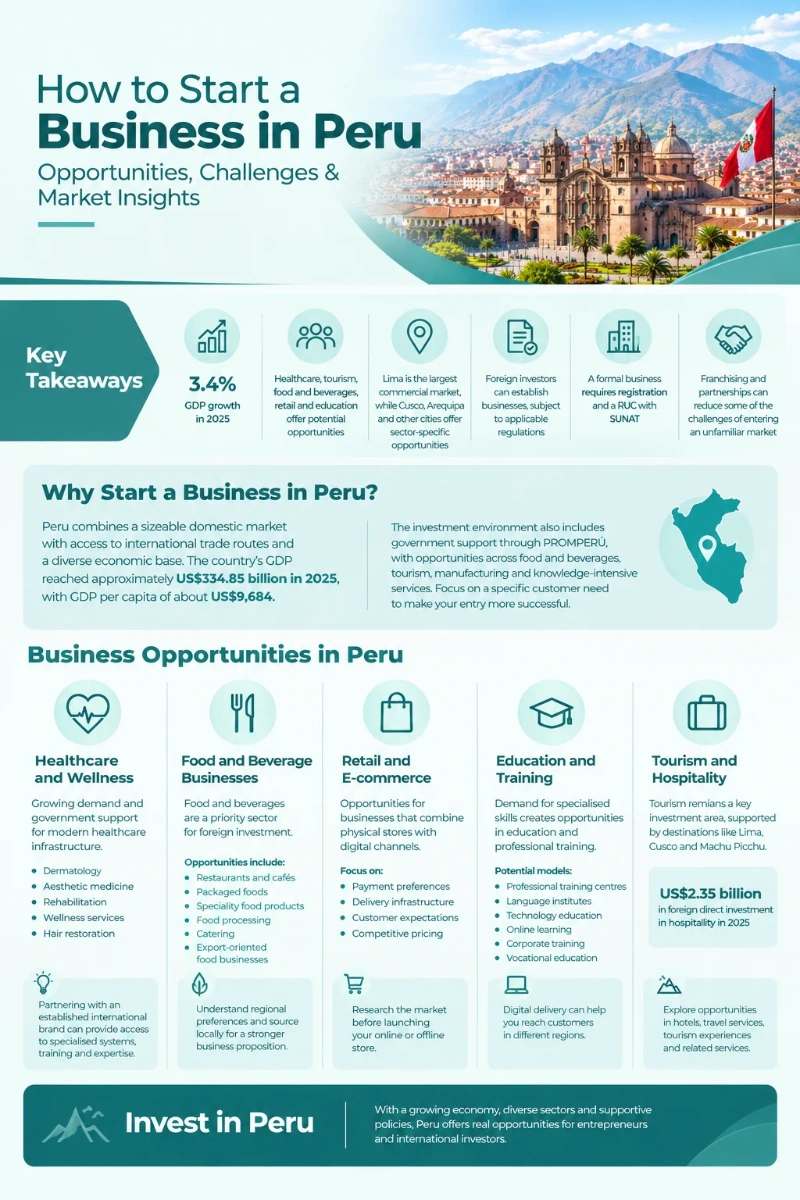
If you are exploring how to start a business in Peru, the country offers opportunities across healthcare, tourism, food and beverages, retail, education and digital services. Peru’s economy grew 3.4% in 2025, while the World Bank projects 3.1% growth for 2026.
The country’s growing consumer base, established investment framework and diverse regional economies make it worth considering for both local entrepreneurs and international investors. However, understanding registration, taxation, regulations, financing and local demand is essential before you invest.
Key Takeaways
- Peru recorded 3.4% GDP growth in 2025.
- Healthcare, tourism, food and beverages, retail and education offer potential business opportunities.
- Lima remains the largest commercial market, while Cusco, Arequipa and other cities offer sector-specific opportunities.
- Foreign investors can establish businesses in Peru, subject to applicable regulations.
- A formal business generally requires registration and a RUC with SUNAT.
- Healthcare and wellness can be an interesting area for specialised businesses, including hair restoration clinics.
- Franchising and partnerships can reduce some of the challenges of entering an unfamiliar market.
Why Start a Business in Peru?
Peru combines a sizeable domestic market with access to international trade routes and a diverse economic base. The World Bank reports that the country’s GDP reached approximately US$334.85 billion in 2025, with GDP per capita of about US$9,684.
The investment environment also includes dedicated government support. PROMPERÚ’s investment promotion platform highlights opportunities across sectors such as food and beverages, tourism, manufacturing and knowledge-intensive services.
For you as an entrepreneur, the opportunity becomes more attractive when you identify a specific customer need rather than entering the market simply because the economy is growing.
Business Opportunities in Peru
Healthcare and Wellness
Healthcare is an important area for potential investment in Peru. Public investment is also supporting the expansion and modernisation of healthcare infrastructure.
PROINVERSIÓN reported in 2025 that seven healthcare projects worth more than US$2 billion were being promoted through public-private partnerships across Lima, Piura and Cajamarca.
Private healthcare and wellness businesses can explore specialised services based on local demand. This includes dermatology, aesthetic medicine, rehabilitation, wellness services and hair restoration.
For an entrepreneur considering a hair transplant clinic, working with an established international hair restoration brand can provide access to specialised clinical systems, training and operational expertise.
This is where DHI International can be relevant. Its international hair restoration model provides an opportunity for investors interested in establishing specialised hair transplant services in markets such as Peru.
Food and Beverage Businesses
Food and beverages remain important sectors within Peru’s investment ecosystem. PROMPERÚ has identified food and beverages as one of its priority sectors for attracting foreign investment. In 2025, it also began developing an investment opportunity portfolio covering food and beverages and diverse manufacturing. You can explore opportunities in:
- Restaurants and cafés
- Packaged foods
- Speciality food products
- Food processing
- Catering
- Export-oriented food businesses
Understanding regional preferences and sourcing locally can help you develop a stronger business proposition.
Retail and E-commerce
Peru’s retail sector provides opportunities for businesses that combine physical stores with digital channels.
E-commerce can help you reach customers beyond a single neighbourhood or city. Before launching, research payment preferences, delivery infrastructure, customer expectations and the competitive pricing of existing online businesses.
Education and Training
Education and professional training can offer opportunities in areas where customers need specialised skills. Potential models include:
- Professional training centres
- Language institutes
- Technology education
- Online learning
- Corporate training
- Vocational education
Digital delivery can also allow you to serve customers across different regions without establishing multiple physical locations.
Tourism and Hospitality
Tourism remains an important part of Peru’s investment proposition, supported by destinations such as Lima, Cusco and Machu Picchu. Invest Peru reports US$2.35 billion in foreign direct investment in hospitality and tourism between 2003 and April 2024, covering 45 projects and more than 15,600 jobs.
Opportunities extend beyond conventional hotels. You can consider:
- Boutique accommodation
- Restaurants
- Travel agencies
- Adventure tourism
- Wellness tourism
- Cultural experiences
- Specialised travel services
How to Start a Business in Peru: Step-by-Step
1. Research the Peruvian Market
Start by identifying your target customer, competitors, pricing and location.
Use reliable market data and speak with local professionals before committing capital. Your research should answer one basic question: What problem will your business solve for customers in Peru?
2. Choose the Right Business Structure
According to SUNAT, you can operate as a Persona Natural or establish a Persona Jurídica. A legal entity operates separately from you as an individual and has its own rights and obligations.
Your choice should depend on your business size, liability considerations, ownership structure and long-term plans.
3. Register Your Business
For a legal entity, company formation can be completed through the SID-SUNARP digital platform for eligible company structures. SUNARP states that its process allows company information and incorporation documents to be submitted electronically through a selected notary.
Once the company is established, you need to activate the relevant RUC with SUNAT.
4. Understand Tax and Regulatory Requirements
The RUC is an 11-digit taxpayer identification number issued by SUNAT. Businesses must register and select the appropriate tax regime according to their activities and circumstances.
Your tax obligations can vary depending on your business structure and sector, so professional local advice is recommended.
Healthcare businesses may also have additional professional, licensing and operational requirements.
5. Open a Business Bank Account
Once your business documentation is in place, establish a dedicated business banking relationship.
Keeping business and personal finances separate makes accounting, tax reporting and financial management easier.
6. Set Up Operations
Choose your premises, hire employees, establish suppliers and put accounting and customer service systems in place.
If you are starting a healthcare business, clinical infrastructure, qualified professionals, patient safety procedures and appropriate equipment should receive particular attention.
7. Launch and Market Your Business
Your launch strategy should reflect how Peruvian consumers search for and evaluate businesses. Consider:
- Local SEO
- Social media
- Paid advertising
- Referral marketing
- Partnerships
- Educational content
- Customer reviews
For specialised healthcare services, informative content can also help potential patients understand treatments before they schedule a consultation.
How Much Does It Cost to Start a Business in Peru?
There is no single amount that applies to every business. Your total investment will depend on:
- Business structure
- Industry
- Location
- Premises
- Equipment
- Staffing
- Inventory
- Licences and professional services
- Marketing
- Working capital
Even company registration costs can vary according to the structure and capital involved. SUNARP’s published incorporation guidance, for example, includes registration fees linked to the company’s capital.
A small digital business can require significantly less initial capital than a restaurant, healthcare clinic or manufacturing operation.
Create a financial plan covering at least the first 12 months rather than calculating only the cost of opening your doors.
Challenges of Starting a Business in Peru
Understanding Local Regulations
Regulatory requirements can vary according to the industry and business structure.
Solution: Work with a qualified local accountant, lawyer or business consultant before registration and launch.
Competition in Major Cities
Lima has a large consumer market, but it also has considerable competition.
Solution: Identify a specific customer segment and develop a clear value proposition rather than competing only on price.
Access to Financing
Funding requirements can be challenging for new businesses, particularly when substantial equipment or premises are involved.
Solution: Prepare a detailed business plan, realistic cash-flow projections and multiple funding options before launching.
Finding Skilled Employees
Specialised sectors require appropriately trained professionals.
Solution: Build recruitment plans early and consider partnerships with professional institutions or established operators.
Managing Economic and Market Uncertainty
Economic conditions can change, affecting consumer spending and business costs. Peru’s economy nevertheless recorded 3.4% growth in 2025, with the World Bank attributing growth to strong private investment and consumption.
Solution: Maintain sufficient working capital and regularly review pricing, demand and operating costs.
Starting a Business in Peru as a Foreign Investor
Foreign entrepreneurs can establish businesses in Peru, but you should understand local incorporation, taxation, immigration and sector-specific requirements before investing. PROMPERÚ provides dedicated investor services and guides for foreign companies, including resources covering the establishment of businesses in Peru.
If you are unfamiliar with the country, working with local professionals can help you understand:
- Company formation
- Tax registration
- Employment rules
- Commercial contracts
- Sector-specific licences
- Banking requirements
- Foreign investment procedures
For international investors, partnerships and franchises can also provide access to local expertise while retaining support from an established international brand.
Start Franchise Business in Peru
Join DHI TodayBest Cities in Peru to Start a Business
Below are the following cities which can be considered. However, the best city ultimately depends on your industry, customer profile, operating costs and competition.
1. Lima
Lima is the country’s largest commercial centre and offers the broadest customer base across many sectors. INEI’s 2025 projections put Lima Metropolitana’s population at approximately 10.43 million.
2. Arequipa
Arequipa is an important regional economic centre with opportunities across services, tourism, commerce and healthcare.
3. Cusco
Cusco’s strong tourism economy creates opportunities in hospitality, travel, food, wellness and specialised tourism services.
4. Trujillo
Trujillo is another major urban centre with opportunities across commerce, services, agriculture-linked businesses and healthcare.
Conclusion
Knowing how to start a business in Peru is only the first step. Your success will depend on choosing the right sector, understanding your customers, complying with local requirements and building a sustainable financial model.
For entrepreneurs considering a specialised healthcare venture, a franchise or partnership with an established international brand can provide a more structured starting point. If you are considering a hair transplant clinic in Peru, DHI International can help you explore the possibilities of entering the hair restoration sector with an established international model, specialised expertise and structured support.
FAQs
1. Is Peru a good country to start a business?
Peru offers opportunities across healthcare, tourism, food and beverages, retail, education and other sectors. Its economy grew 3.4% in 2025, according to the World Bank. Your success will depend on market demand, location, competition and regulatory compliance.
2. Can foreigners start a business in Peru?
Yes. Foreign investors can establish businesses in Peru, subject to applicable legal, tax, immigration and sector-specific requirements. PROMPERÚ also provides resources and assistance for foreign investors.
3. How much money do I need to start a business in Peru?
The amount depends on your business model. A digital business may require relatively limited capital, while a healthcare clinic, restaurant or manufacturing operation can require considerably more. Prepare a detailed budget covering setup costs and working capital.
4. What are the most profitable businesses in Peru?
Potential opportunities exist in healthcare, tourism, food and beverages, retail, education, technology and specialised services. Profitability depends on your location, target customers, competition and operating model.
5. What are the best franchise opportunities in Peru?
The right franchise depends on your investment capacity and experience. Healthcare, food, education, wellness and specialised services can all offer franchise possibilities. You should evaluate brand support, fees, training, territory and expected returns before investing.
6. What are the biggest challenges of doing business in Peru?
Common challenges include understanding regulations, finding skilled employees, securing financing, managing competition and adapting to changing market conditions. Local professional advice and detailed market research can help address these issues.
7. Which city is best for starting a business in Peru?
Lima offers the largest population and broadest commercial market, while cities such as Arequipa, Cusco and Trujillo can offer opportunities in specific sectors. Your industry and target audience should determine the best location.
8. How long does it take to register a business in Peru?
The timeframe depends on your business structure and the procedures involved. SUNARP states that its SID-SUNARP company formation process has a 24-hour qualification period for the applicable registration process, although the complete process can involve additional steps with a notary and SUNAT.