Medical Tourism in Vietnam: A Growing Business Opportunity
Vietnam is gaining attention as a potential destination for international healthcare, supported by improving medical infrastructure, skilled healthcare professionals and competitive treatment costs. The government is also actively developing medical tourism, with plans to establish internationally oriented healthcare centres and connect medical services with tourism.
For investors, this creates opportunities across specialised healthcare, aesthetic medicine, wellness and hair restoration. With international arrivals reaching nearly 21.2 million in 2025, Vietnam also has a large and growing pool of visitors who could potentially access private healthcare services during their stay.
Key Takeaways
- Vietnam is developing medical tourism as part of its healthcare and tourism strategy.
- Competitive costs and improving healthcare capabilities can support international patient demand.
- Vietnam welcomed nearly 21.2 million international visitors in 2025, up 20.4% from 2024.
- Aesthetic medicine and hair restoration can offer opportunities within the private healthcare segment.
- Hair transplant clinics can serve both local patients and international visitors.
- Franchise partnerships can provide investors with established clinical protocols, training and operational support.
Why Is Medical Tourism Growing in Vietnam?
Affordable Healthcare Costs
Treatment affordability is one factor supporting Vietnam’s medical tourism potential. The Ministry of Health has specifically identified reasonable costs, qualified healthcare professionals and improving medical infrastructure as advantages for developing medical tourism.
Cost, however, should not be considered in isolation. International patients also evaluate:
- Doctor qualifications
- Clinical standards
- Technology
- Treatment outcomes
- Communication
- Recovery support
- Transparency in pricing
For healthcare businesses, combining competitive pricing with reliable clinical quality can create a stronger proposition.
Improving Healthcare Infrastructure
Vietnam’s healthcare infrastructure has continued to develop, particularly in major urban centres. The Ministry of Health’s 2025-2030 plans include developing healthcare centres that meet international standards and prioritising locations such as Hanoi, Ho Chi Minh City, Da Nang, Khanh Hoa and Quang Ninh.
The proposed strategy also includes dedicated areas for international patients, upgraded facilities and stronger foreign-language capabilities.
Increasing Healthcare Expertise
Vietnam has a growing base of medical professionals and specialised healthcare institutions. The government is seeking to improve international healthcare capabilities through professional training, foreign-language education, international cooperation and higher clinical standards. Its proposed medical tourism strategy targets at least 15 hospitals meeting international quality standards such as JCI or equivalent by 2030.
For private healthcare investors, this creates opportunities to build services around specialised medical expertise rather than competing purely on price.
Growing International Connectivity
International patient acquisition depends partly on how easily patients can reach and communicate with healthcare providers. Vietnam’s tourism sector provides a strong foundation. The country welcomed nearly 21.2 million international visitors in 2025, with more than 17.8 million arriving by air.
This expanding international visitor base can support healthcare businesses that are equipped to communicate with overseas patients and coordinate appointments, treatment and follow-up care.
Government Support and Healthcare Development
Government policy is becoming increasingly supportive of medical tourism.
The Ministry of Health and Ministry of Culture, Sports and Tourism signed a cooperation agreement for healthcare and tourism development covering 2025-2030. The initiative includes developing healthcare tourism products, supporting cooperation between healthcare providers and tourism companies, and improving staff training.
The government is also considering integrated models that connect hospitals, hotels, resorts and travel companies in key tourism destinations.
Popular Medical Tourism Services in Vietnam
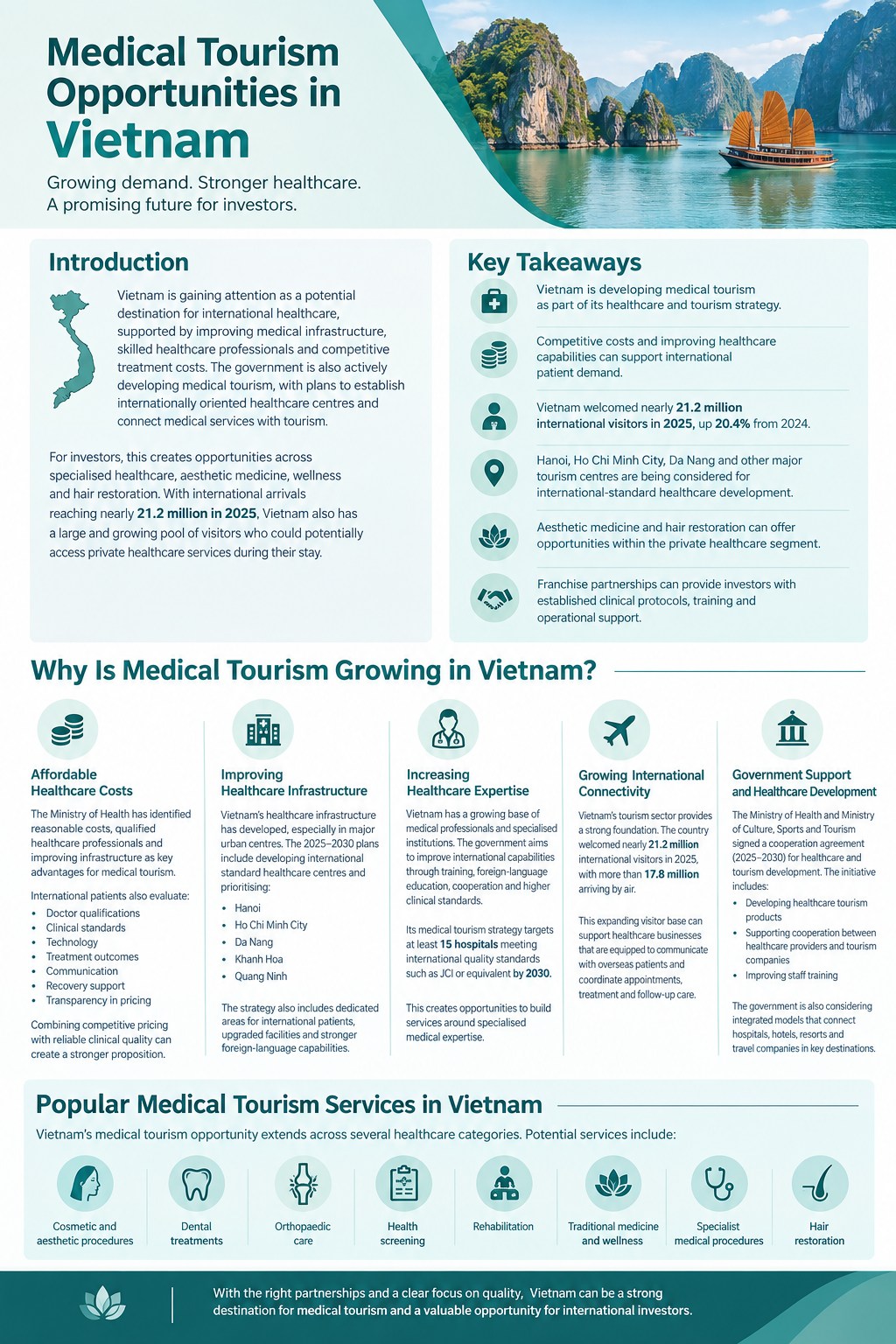
Vietnam’s medical tourism opportunity extends across several healthcare categories. Potential services include:
- Cosmetic and aesthetic procedures
- Dental treatments
- Orthopaedic care
- Health screening
- Rehabilitation
- Traditional medicine and wellness
- Specialist medical procedures
- Hair restoration
The government has specifically identified high-quality medical services, traditional medicine and wellness-related packages as areas that can be combined with tourism.
For private investors, specialised services can provide an opportunity to build a focused patient proposition rather than operating as a general healthcare provider.
The Growing Hair Transplant Market in Vietnam
Hair restoration can be particularly relevant to medical tourism in Vietnam because treatment can often be planned in advance, allowing international patients to combine a clinical visit with accommodation and recovery time.
Hair loss is also a widespread medical and aesthetic concern. A population-based study of 1,005 men aged 30-50 found that 58% had androgenetic alopecia, with prevalence increasing with age.
This study was not conducted specifically in Vietnam, so it should not be interpreted as a Vietnam-specific prevalence figure. However, it demonstrates the substantial prevalence of male pattern hair loss internationally.
For Vietnam, the opportunity lies in developing specialised clinics that can deliver appropriate diagnosis, treatment planning and follow-up for both domestic and international patients.
Why Hair Restoration Is a Business Opportunity in Vietnam
Growing Demand for Hair Transplant Procedures
Greater awareness of hair loss and increasing access to information are encouraging more people to explore medical treatment options.
Patients today can research procedures, compare clinics and assess treatment approaches before making an appointment.
A specialised hair restoration clinic can therefore target patients who are actively looking for professional solutions rather than general cosmetic services.
Increasing Interest in Advanced Hair Restoration Techniques
Modern hair transplantation focuses heavily on natural hairlines, appropriate graft placement and minimally invasive techniques.
DHI International’s Direct Hair Implantation technique uses specialised implanters designed to give doctors control over design, density, depth, angle and direction during implantation.
For an investor, offering a specialised technique through trained doctors can help create a clear market position.
Scope for Specialized Hair Clinics
Hair restoration requires specific expertise, equipment and clinical protocols.
This creates an opportunity for dedicated clinics rather than treating hair transplantation as an additional service within a general aesthetic centre.
A specialised clinic can focus on:
- Hair loss diagnosis
- Individual treatment planning
- Hair transplantation
- Post-treatment monitoring
- Patient education
- Long-term hair management
Opportunities to Serve Local and International Patients
A clinic in Vietnam can potentially serve two customer segments: local patients and international patients.
International patients may be attracted by the combination of specialised healthcare, competitive costs and Vietnam’s tourism infrastructure.
However, international patient services require additional planning, including multilingual communication, appointment coordination, airport or hotel assistance where appropriate and clear aftercare instructions.
Why Consider a Hair Transplant Franchise in Vietnam?
Starting a specialised medical clinic independently requires you to develop the brand, clinical protocols, staff training, marketing systems and operational processes.
A franchise model can provide an established framework.
Start Hair Transplant Franchise in Vietnam
Join DHI TodayDHI Medical Group states that it operates 75 clinics across 45 countries and has more than 56 years of experience in hair restoration. Its franchise model includes doctor training, clinical protocols, marketing support and operational guidance.
For investors considering Medical Tourism in Vietnam, this type of partnership can offer several potential advantages:
- Established international brand
- Specialist hair restoration expertise
- Doctor training and certification
- Standardised clinical protocols
- Marketing support
- Patient management systems
- Operational guidance
- International network and experience
DHI also identifies Vietnam as one of the markets with potential for a new DHI clinic opportunity in 2026.
Key Factors to Consider Before Starting a Medical Tourism Business in Vietnam
Market and Location Research
Study your target patients, competing clinics, treatment prices and accessibility before selecting a location.
Major cities such as Hanoi and Ho Chi Minh City offer established healthcare infrastructure, while destinations such as Da Nang and Khanh Hoa combine healthcare potential with strong tourism activity.
Regulatory and Licensing Requirements
Healthcare businesses must comply with applicable Vietnamese healthcare regulations, professional requirements and licensing procedures.
Before investing, consult qualified local legal and healthcare professionals to establish exactly which approvals your business requires.
Healthcare Expertise and Technology
International patients expect qualified professionals and reliable clinical standards. Your investment plan should therefore account for:
- Qualified doctors
- Trained clinical staff
- Appropriate medical equipment
- Clinical protocols
- Infection-control standards
- Patient safety systems
Patient Experience and Aftercare
Medical tourism does not end when the procedure is completed. International patients need clear instructions about recovery, follow-up appointments and what to do after returning home.
A 2020 study based on interviews with 10,143 patients across 69 Vietnamese public hospitals found that patient satisfaction was influenced by factors including healthcare costs, staff and hospital experience.
For international healthcare businesses, this reinforces the importance of the complete patient experience.
Marketing and International Patient Acquisition
Your marketing strategy should make it easy for international patients to understand:
- What treatment you provide
- Who performs the procedure
- What technology is used
- Expected recovery
- Potential risks
- Treatment costs
- How follow-up works
Multilingual websites, educational content, international partnerships and digital consultations can support patient acquisition.
The Future of Medical Tourism and Hair Restoration in Vietnam
The outlook for Medical Tourism in Vietnam is becoming increasingly positive.
The Ministry of Health is working toward international-quality healthcare centres, stronger cooperation between healthcare and tourism businesses and dedicated services for international patients.
Tourism growth adds another advantage. Vietnam recorded its highest-ever number of international visitors in 2025, reaching nearly 21.2 million, and the country has set a target of 25 million international visitors for 2026.
For hair restoration businesses, this creates an opportunity to develop services that are accessible to both Vietnamese patients and visitors seeking specialised treatment.
The strongest opportunities will likely belong to providers that combine medical expertise, appropriate technology, transparent communication and reliable aftercare.
Conclusion
Medical Tourism in Vietnam is developing through the combined growth of healthcare capabilities, tourism infrastructure and government support. For investors, opportunities span specialist healthcare, aesthetics, wellness, and hair restoration. Hair transplant clinics can be particularly interesting because they can serve local demand while also attracting international patients seeking specialised procedures.
However, success requires more than opening a clinic. You need qualified medical professionals, appropriate technology, regulatory compliance, strong patient communication and a clear acquisition strategy.
FAQs
1. Is medical tourism growing in Vietnam?
Yes. Vietnam’s government is actively developing medical tourism as part of its 2025–2030 healthcare and tourism strategy. The country also welcomed nearly 21.2 million international visitors in 2025, creating a large international visitor base.
2. Is hair transplant popular in Vietnam?
Interest in hair restoration is increasing as patients gain greater awareness of professional hair-loss treatments and advanced transplantation techniques. However, reliable public data showing the exact number of hair transplant procedures performed annually in Vietnam is limited.
3. Is Vietnam a good country for starting a hair transplant business?
Vietnam can offer an interesting opportunity because of its growing healthcare capabilities, tourism sector and government interest in medical tourism. Investors should still assess local competition, regulations, staffing and patient demand before making a decision.
4. How much does it cost to start a hair transplant clinic in Vietnam?
There is no standard investment amount. Your costs will depend on the city, clinic size, equipment, staffing, technology, licensing, marketing and business model. A franchise may have additional fees but can provide established systems and support.
5. What are the benefits of a hair transplant franchise?
A franchise can provide an established brand, doctor training, clinical protocols, marketing support, operational guidance and patient management systems. DHI’s franchise model includes these areas as part of its international business framework.
6. Can foreigners invest in a healthcare business in Vietnam?
Foreign investment in Vietnam’s healthcare sector is possible, but the exact requirements depend on the business structure and healthcare activity. You should obtain current advice from qualified Vietnamese legal and investment professionals before establishing a healthcare business.
7. Why choose a hair transplant franchise instead of starting a clinic independently?
A franchise can reduce the need to develop your clinical systems, training programmes, brand identity and operational processes from the beginning. This can be particularly useful when you are entering a specialised healthcare segment or a market that is new to you.