
Australia’s Healthcare Market: Opportunities for Local and International Investors

Australia has a well-established healthcare system, a strong healthcare system supported by strong public investment, advanced medical infrastructure and growing demand for specialised services. The Healthcare Market in Australia is also benefiting from population growth, ageing demographics and increasing adoption of digital health technologies.
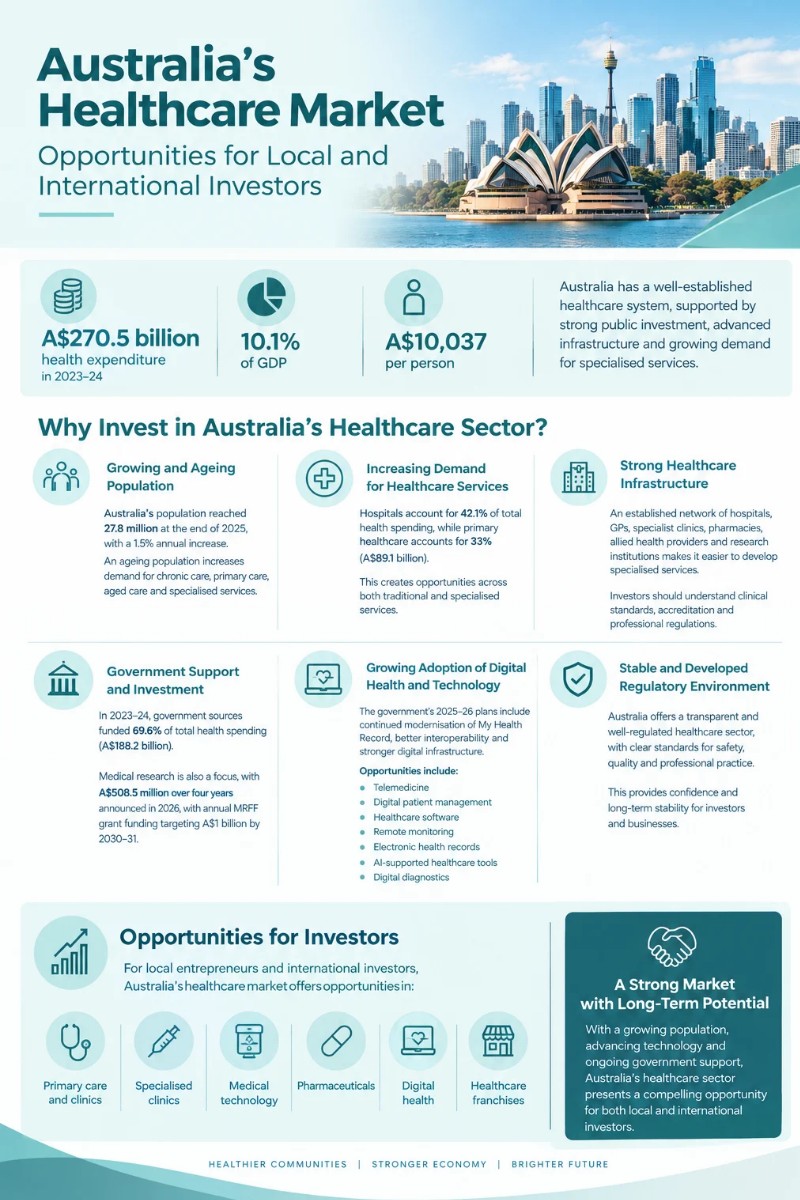
Australia spent an estimated A$270.5 billion on health in 2023–24, or 10.1% of GDP, or A$10,037 per person.
For local entrepreneurs and international investors, this creates opportunities across primary care, specialised clinics, medical technology, digital health, pharmaceuticals and healthcare franchises.
Key Takeaways
- Australia has a large and well-developed healthcare system.
- Healthcare expenditure reached A$270.5 billion in 2023-24.
- Population growth is increasing demand for healthcare services.
- Digital health and medical technology are receiving significant government support.
- Specialised clinics, including hair transplant clinics, present opportunities for investors.
- International investors can consider partnerships, acquisitions, franchises or new healthcare businesses.
- Healthcare investment requires careful attention to regulation, workforce requirements and operating costs.
Why Invest in Australia’s Healthcare Sector?
Growing and Ageing Population
Australia’s population reached 27.8 million at the end of December 2025, growing by 1.5% over the preceding year. Net overseas migration contributed 301,000 people to this increase.
Population growth creates sustained demand for healthcare, while an ageing population increases the need for chronic disease management, primary care, aged care, rehabilitation and specialised medical services.
For investors, this means healthcare demand is supported by long-term demographic factors rather than short-term trends alone.
Increasing Demand for Healthcare Services
Australia’s healthcare expenditure demonstrates the scale of the sector. In 2023–24, hospitals accounted for 42.1% of total health spending, while primary healthcare accounted for 33%, equivalent to A$89.1 billion.
This spending covers a broad ecosystem, giving investors opportunities across both traditional medical services and specialised healthcare businesses.
Strong Healthcare Infrastructure
Australia has an established network of hospitals, general practices, specialist clinics, pharmacies, allied health providers and research institutions.
This infrastructure can make it easier for investors to develop specialised services that complement the existing healthcare system.
For international businesses, however, understanding Australia’s clinical standards, accreditation requirements and professional regulations remains essential before entering the market.
Government Support and Investment
Government funding continues to play a major role in Australia’s healthcare system.
In 2023–24, government sources funded 69.6% of Australia’s total health spending, amounting to A$188.2 billion.
Medical research is another area receiving support. In 2026, the Australian Government announced more than A$508.5 million over four years in additional Medical Research Future Fund investment, with annual MRFF grant funding targeted to reach A$1 billion by 2030–31.
Growing Adoption of Digital Health and Technology
Digital health is becoming increasingly important across Australia’s healthcare system. The government’s 2025–26 health portfolio plans include continued modernisation of My Health Record, improved interoperability and stronger digital health infrastructure. For investors, opportunities can therefore extend beyond physical clinics to:
- Telemedicine
- Digital patient management
- Healthcare software
- Remote monitoring
- Electronic health records
- AI-supported healthcare tools
- Digital diagnostics
Stable and Developed Economy
Australia offers investors a developed economy, established financial institutions and a mature regulatory environment.
The country’s foreign investment framework has also been updated to streamline lower-risk investments while maintaining scrutiny around national security and other risks.
This provides a structured environment for investors, provided you understand the relevant approval and compliance requirements.
Top Healthcare Investment Opportunities in Australia
Hair Transplant Clinic
Hair restoration is a specialised healthcare segment with potential for private clinic investment. A hair transplant clinic can serve patients seeking solutions for male and female pattern hair loss, provided treatments are delivered by appropriately qualified medical professionals.
Advanced procedures such as FUE and DHI can also create opportunities for clinics seeking to differentiate themselves through specialised expertise and patient-focused treatment.
For international hair restoration brands, Australia can offer opportunities through partnerships, franchises and the development of specialised clinics.
Start Hair Restoration Franchise in Australia
Join DHI TodayPrimary Care and Medical Clinics
Primary care remains one of the largest areas of healthcare spending in Australia. Investors can consider GP clinics, specialist practices, urgent care centres and other outpatient services.
The government’s Strengthening Medicare program is also supporting primary care modernisation, including digital health capability and practice infrastructure.
Allied Health and Wellness Services
Physiotherapy, psychology, occupational therapy, nutrition and rehabilitation services are important parts of Australia’s healthcare ecosystem.
An ageing population and increasing focus on preventive care can support continued demand for these services.
Medical Technology and Healthcare Innovation
Australia has an active medical research and innovation ecosystem. In 2025, the Australian Government announced almost A$100 million for biomedical and medical technology innovation through three organisations supporting commercialisation of emerging healthcare technologies.
This creates opportunities in medical devices, diagnostics, biotechnology and healthcare technology.
Digital Health and Telemedicine
Digital healthcare can help providers improve access, communication and patient management.
Investors can explore solutions that support:
- Virtual consultations
- Remote patient monitoring
- Digital records
- Appointment management
- AI-assisted workflows
- Patient engagement
Pharmaceutical and Biotechnology
Australia’s research capabilities and government-backed medical innovation programs provide opportunities for pharmaceutical and biotechnology businesses.
The government’s Medical Research Commercialisation initiative is providing A$450 million over 10 years from 2024–25 to support early-stage health and medical research, including medicines, devices and digital health technologies.
Opportunities for Local Investors
Local investors have an advantage in understanding Australia’s consumer behaviour, healthcare regulations and regional demand. You can explore:
- Acquiring an existing clinic
- Opening a specialised medical centre
- Expanding an existing healthcare business
- Investing in healthcare technology
- Building a healthcare franchise
- Partnering with medical professionals
Existing businesses can also add specialised services to their current offerings. For example, an aesthetic or dermatology practice could evaluate whether hair restoration services are suitable for its patient base.
Opportunities for International Investors
International investors can enter the Australian healthcare market through several routes.
Australia’s foreign investment framework allows commercial investment while giving the Treasurer powers to review proposals against national interest and national security considerations.
Recent data also shows substantial international investment activity. During January–March 2026, approved commercial investment proposals totalled A$79.7 billion across 311 proposals, with services accounting for A$42.5 billion.
Potential entry models include:
- Establishing a new healthcare business
- Acquiring an existing provider
- Creating a franchise
- Partnering with an Australian healthcare organisation
- Licensing specialised technology or treatment systems
Challenges and Considerations for Healthcare Investors
Healthcare can offer attractive opportunities, but you need to evaluate the sector carefully.
Regulatory requirements
Healthcare businesses operate under strict professional and regulatory standards. Your business model should be reviewed against applicable federal and state requirements.
Workforce availability
Qualified doctors, nurses, technicians and allied health professionals are essential. Recruitment and retention should be included in your financial planning.
Operating costs
Staffing, premises, technology, insurance, equipment and compliance can create significant expenses.
Competition
Australia has an established healthcare sector. Your proposition should therefore offer a clear reason for patients and healthcare professionals to choose your service.
Patient trust
Healthcare businesses depend heavily on reputation. Clinical quality, transparency and patient experience should remain central to your strategy.
How to Enter Australia’s Healthcare Market
Start a New Healthcare Business
This gives you maximum control over your brand, services and operating model. However, you will need to establish the infrastructure, team, systems and patient acquisition strategy yourself.
Acquire an Existing Healthcare Business
Acquisition can provide access to an established patient base, trained employees and existing infrastructure.
Before investing, carefully review the business’s financial performance, regulatory history, staffing and reputation.
Invest in a Healthcare Franchise
A franchise can provide access to an established brand, operating systems, training and business support.
This model can be particularly relevant when you are entering a specialised healthcare segment where developing clinical and operational systems independently could require considerable time and expertise.
Partner with an Established Healthcare Provider
Partnerships can combine your investment capability with an existing provider’s local knowledge, medical expertise and infrastructure.
For international investors, this approach can also provide a practical understanding of local market requirements.
Why Healthcare Franchising Can Be an Attractive Investment Model
Healthcare franchising can reduce some of the challenges involved in building a specialised healthcare brand from the ground up. Depending on the franchise, you may receive:
- Brand recognition
- Training and certification
- Clinical protocols
- Operational systems
- Marketing support
- Technology guidance
- Business development assistance
For a specialised segment such as hair restoration, an established international brand can provide additional clinical and operational expertise.
Key Factors to Evaluate Before Investing
Before investing capital to the Australia’s Healthcare Market, assess:
- Market demand – Identify your target patients and understand their needs.
- Regulatory requirements – Determine which licences, registrations and approvals apply.
- Location – Evaluate population growth, competition, accessibility and local demographics.
- Medical workforce – Confirm whether appropriately qualified professionals are available.
- Investment requirements – Account for premises, equipment, staff, technology, marketing and working capital.
- Business model – Compare independent ownership, acquisition, partnership and franchise options.
- Long-term scalability – Consider whether the model can expand into additional locations or services.
Conclusion
The Australia Healthcare Market offers opportunities across primary care, specialised clinics, allied health, medical technology, digital health, pharmaceuticals and healthcare franchising.
The scale of healthcare spending, population growth, government support for innovation and continued digitalisation create favourable conditions for well-planned healthcare investments. Australia’s population reached 27.8 million in December 2025, while total health expenditure reached A$270.5 billion in 2023–24.
For investors interested in specialised healthcare, hair restoration can be one area worth evaluating. A franchise or partnership with an established international provider can offer a structured entry model while providing access to established clinical systems and expertise.
If you are considering a hair restoration opportunity in Australia, explore how DHI International can support your plans through its international hair restoration model and specialised expertise.
FAQs
1. Is Australia a good country for healthcare investment?
Yes. Australia has a large, established healthcare system, significant healthcare expenditure, strong infrastructure and government-backed investment in healthcare innovation. However, investors should assess regulations, workforce availability, location and operating costs before committing capital.
2. What are the biggest healthcare investment opportunities in Australia?
Key opportunities include primary care, specialised medical clinics, allied health, digital health, medical technology, pharmaceuticals, biotechnology and healthcare franchises. Hair restoration clinics can also be considered within the specialised private healthcare segment.
3. Can international investors invest in Australia’s healthcare sector?
Yes. International investors can establish, acquire or partner with healthcare businesses in Australia, subject to applicable foreign investment and healthcare regulations. Australia’s foreign investment framework outlines when proposals may require review.
4. Is healthcare franchising a good investment opportunity in Australia?
Healthcare franchising can be suitable for investors who want an established business framework, brand support, training and operational systems. You should assess the franchise’s financial model, clinical standards, fees, territory and support structure before investing.
5. What are the challenges of investing in Australia’s healthcare market?
Common considerations include regulatory compliance, staffing, operating costs, competition, location and patient acquisition. Detailed due diligence and advice from qualified Australian legal, financial and healthcare professionals can help reduce these risks.
6. How much does it cost to start a healthcare business in Australia?
There is no standard investment amount. Costs vary considerably depending on the type of healthcare business, location, premises, equipment, staffing, technology and regulatory requirements. A specialised clinic may require a different investment level from a GP practice, digital health company or franchise.
Related Blogs

 Siddharth Kumar
Medical Tourism in Vietnam: A Growing Business Opportunity
 Siddharth Kumar