

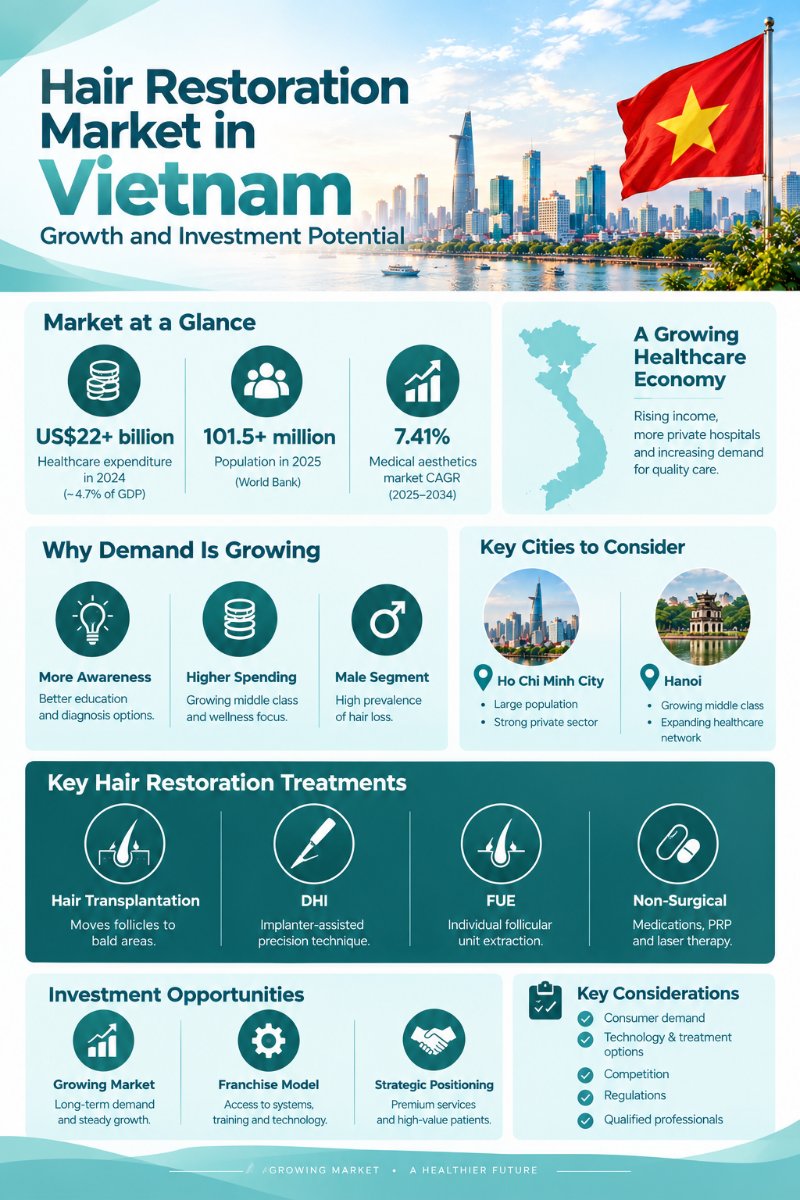
Vietnam’s healthcare sector is expanding as the country’s economy grows, its middle class increases, and demand for higher-quality healthcare services rises. Healthcare expenditure exceeded US$22 billion in 2024, equivalent to around 4.7% of GDP, according to the U.S. Department of Commerce. The country also had a population of more than 101.5 million in 2025, according to World Bank data.
These conditions create opportunities for specialised healthcare businesses, including hair restoration. If you are exploring Hair Restoration in Vietnam as an investment opportunity, you need to assess consumer demand, treatment technologies, competition, regulations, staffing requirements, and the business model before committing capital.
Key Takeaways
- Vietnam has a large and growing consumer market with increasing healthcare spending.
- Demand for aesthetic and minimally invasive services is supporting the wider medical aesthetics sector.
- Hair transplantation, DHI, FUE, and non-surgical treatments represent different opportunities within hair restoration.
- Ho Chi Minh City and Hanoi are important markets to assess because of their population, healthcare infrastructure, and concentration of private services.
- A franchise can provide access to established clinical systems, training, technology, marketing, and operational support.
- Regulatory compliance and qualified medical professionals are essential when establishing a hair restoration business.
Overview of the Hair Restoration Market in Vietnam
The hair restoration opportunity in Vietnam is closely tied to the country’s broader healthcare and aesthetic medicine development.
Vietnam’s healthcare expenditure surpassed US$22 billion in 2024, while the private hospital sector has expanded to 384 facilities, representing about 24% of the country’s hospitals, according to the U.S. Department of Commerce. The wider medical aesthetics market also provides useful context. IMARC estimates that Vietnam’s medical aesthetics market reached US$98.4 million in 2025 and could reach US$190.8 million by 2034, representing a projected CAGR of 7.41%. The report identifies rising disposable income, medical tourism, private healthcare investment, and demand for minimally invasive procedures among the market drivers.
Hair restoration is a specialised segment within this broader environment. For an investor, the opportunity depends on identifying a target patient group and delivering medically appropriate treatment with consistent clinical standards.
Why Is Hair Restoration Demand Growing in Vietnam?
Rising Awareness of Hair Loss Treatments
Hair loss is increasingly discussed as a medical and aesthetic concern. Patients have access to more information about diagnosis, medical treatment, hair transplantation, and long-term hair management than in previous years.
Scientific research also demonstrates that hair loss can affect quality of life. A systematic review and meta-analysis covering 41 studies and 7,995 patients found measurable impairment in quality-of-life indicators among people with androgenetic alopecia.
One review states that “Alopecia affects many individuals worldwide.” This makes accurate diagnosis and appropriate treatment important parts of a professional hair restoration service.
Increasing Spending on Aesthetic and Wellness Services
Vietnam’s growing middle class and increasing healthcare expenditure are supporting demand for private and specialised services. The country’s medical aesthetics market is projected to grow substantially through 2034, with minimally invasive treatments receiving increasing attention.
For investors, this can create opportunities to position hair restoration within a broader premium healthcare offering.
Growing Interest Among Male Consumers
Men represent a significant patient group for androgenetic alopecia, commonly known as male pattern hair loss.
A population-based study of 1,005 men aged 30–50 found androgenetic alopecia in 58% of participants, with prevalence increasing with age. This study was not conducted in Vietnam, so it should be viewed as scientific context rather than a Vietnam-specific prevalence estimate.
Key Hair Restoration Treatments in Vietnam
Hair Transplantation
Hair transplantation involves moving hair follicles from a donor area to areas affected by hair loss. It can be considered for suitable patients after assessment of hair-loss pattern, donor availability, age, medical history, and long-term expectations.
1. Direct Hair Implantation
Direct Hair Implantation, or DHI, is a specialised hair transplantation approach involving extraction and implantation of follicular units. The technique uses an implanter to place grafts while controlling factors such as angle, direction, depth, and density.
DHI International states that its proprietary DHI technique is performed by trained and certified doctors and supported by its international training system. These are company-provided claims and should be assessed alongside clinical credentials and local regulatory requirements.
2. FUE Hair Transplant
Follicular Unit Extraction, commonly called FUE, involves extracting individual follicular units from the donor area before implantation. Scientific reviews describe FUE as a minimally invasive harvesting technique that can be used for androgenetic alopecia and other hair restoration indications.
The procedure requires appropriate surgical planning and skilled practitioners. Research literature also highlights the importance of experience in reducing complications such as follicular transection.
3. Non-Surgical Hair Loss Treatments
Hair restoration businesses can also offer non-surgical options depending on medical assessment. These may include clinically appropriate medications, scalp treatments, or other therapies.
Investors should ensure that every treatment offered is supported by appropriate clinical evidence and delivered within the scope of local medical regulations.
Investment Opportunities in Vietnam’s Hair Restoration Market
Establishing a Hair Restoration Clinic
Opening an independent clinic gives you control over branding, pricing, services, staffing, and operations. However, you must develop clinical protocols, recruit qualified professionals, purchase equipment, obtain required licences, and build patient demand.
Investing in a Hair Restoration Franchise
A franchise can reduce some of the operational development work by providing an established business framework.
DHI franchise model includes doctor training, clinical protocols, marketing support, operational guidance, CRM systems, and access to an international hair restoration network. The company reports 75 clinics across 45 countries and more than 500,000 patients treated worldwide.
For an investor considering Hair Restoration in Vietnam, this model can be assessed against the costs and requirements of building an independent clinic.
Partnerships With Existing Healthcare Providers
You could also consider partnerships with established hospitals, dermatology clinics, aesthetic centres, or healthcare professionals.
Such partnerships may provide access to existing facilities, patient networks, medical professionals, and local market knowledge. The commercial structure and responsibilities should be clearly defined before entering an agreement.
Hair Restoration Technology and Equipment
Technology represents another potential investment area. Opportunities can include specialised transplantation instruments, diagnostic equipment, digital patient-management systems, imaging technologies, and clinic software.
However, equipment investment should follow clinical requirements rather than technology trends alone.
Why Consider a Hair Restoration Franchise in Vietnam?
A franchise can be useful when you want to enter Hair Restoration in Vietnam without developing every clinical and operational system from the beginning. Potential advantages include:
- Established brand framework
- Doctor training and certification
- Standardised clinical protocols
- Marketing and digital support
- Patient-management systems
- Operational guidance
- Access to international expertise
- Ongoing training and professional development
DHI states that its London Hair Restoration Training Academy trains and certifies surgeons in its proprietary DHI technique.
Key Cities for Hair Restoration Business Opportunities in Vietnam
1. Ho Chi Minh City
Ho Chi Minh City is a major commercial centre with a large urban population, established private healthcare providers, and strong consumer activity. It can be evaluated for premium and specialised healthcare services.
2. Hanoi
Hanoi is another important market for healthcare investment, with major hospitals, medical professionals, private clinics, and an established consumer base.
3. Da Nang
Da Nang can also be considered for investors interested in healthcare services connected to tourism and an expanding urban population. However, local competition, patient demographics, medical staffing, and regulatory requirements should be assessed before selecting the city.
Regulatory Considerations for Hair Restoration Businesses in Vietnam
Healthcare businesses require careful attention to licensing and professional requirements.
Vietnam’s Ministry of Health maintains procedures for licensing healthcare facilities, including requirements under the country’s Law on Medical Examination and Treatment and related regulations. Official administrative information also recognises foreign-invested enterprises among entities that may be subject to healthcare licensing procedures. If you are considering Hair Restoration in Vietnam, your due diligence should cover:
- Business registration and investment structure
- Healthcare facility licensing
- Professional licences for medical practitioners
- Premises and equipment requirements
- Permitted medical procedures
- Patient records and privacy
- Advertising and marketing requirements
- Employment and tax obligations
Working with qualified Vietnamese legal, medical, and financial advisers can help you address these requirements before launch.
DHI International as a Hair Restoration Franchise Opportunity
DHI International presents hair restoration as a specialised franchise opportunity for investors seeking an established medical business model.
The company states that it has more than 56 years of experience in hair restoration and operates across 45 countries. Its franchise programme includes training, clinical protocols, marketing assistance, operational support, and access to its international network.
DHI’s official franchise material also identifies Vietnam among markets where it is seeking franchise opportunities.
If you are evaluating Hair Restoration in Vietnam, you can compare the DHI franchise model with the cost, staffing, technology, training, and marketing requirements involved in establishing an independent clinic.
Invest in Hair Restoration Franchise in Vietnam
Join DHI TodayConclusion
The growth of Vietnam’s healthcare and medical aesthetics sectors creates a market worth examining for specialised healthcare investment. Rising healthcare expenditure, a population exceeding 100 million, expanding private healthcare capacity, and increasing demand for aesthetic services provide useful market signals.
For investors interested in Hair Restoration in Vietnam, opportunities can range from independent clinics and healthcare partnerships to technology and franchise models. Your decision should be based on local patient demand, competition, regulatory requirements, capital needs, medical expertise, and long-term operating costs.
FAQs
1. Is hair transplantation popular in Vietnam?
Hair transplantation is part of the country’s expanding aesthetic healthcare sector. Growing awareness of aesthetic treatments and increasing demand for specialised healthcare services provide a market context worth evaluating, although reliable public data specifically measuring Vietnam’s hair-transplant procedure volume remain limited.
2. How much does it cost to start a hair transplant clinic in Vietnam?
There is no single cost. Your investment can vary according to city, clinic size, premises, medical equipment, staffing, licensing, technology, marketing, franchise fees, and working capital.
3. Can foreigners invest in a healthcare business in Vietnam?
Foreign-invested enterprises are included in Vietnam’s healthcare administrative framework, but the exact requirements depend on the business structure and healthcare activity. Professional legal and regulatory advice should be obtained before investment.
4. Is DHI available in Vietnam?
DHI’s current franchise material identifies Vietnam as a market where it is seeking franchise opportunities. Investors should contact DHI directly to confirm current territory availability and the applicable franchise terms.
5. How can you start a hair transplant franchise in Vietnam?
Start by researching the local market, identifying an appropriate city, confirming territory availability, reviewing investment requirements, understanding healthcare licensing, and evaluating the franchisor’s training and operational support.
6. Which cities in Vietnam offer opportunities for hair restoration businesses?
Ho Chi Minh City and Hanoi are key markets to research because of their large urban populations and established healthcare ecosystems. Da Nang can also be evaluated, particularly where healthcare demand intersects with tourism and urban growth.
7. What should investors consider before opening a hair restoration clinic?
Assess patient demand, competition, location, medical staffing, licensing, equipment, clinical protocols, marketing costs, working capital, and the qualifications of the professionals delivering treatment. If you choose a franchise, review the agreement, territory, support, fees, renewal terms, and exit provisions carefully.